

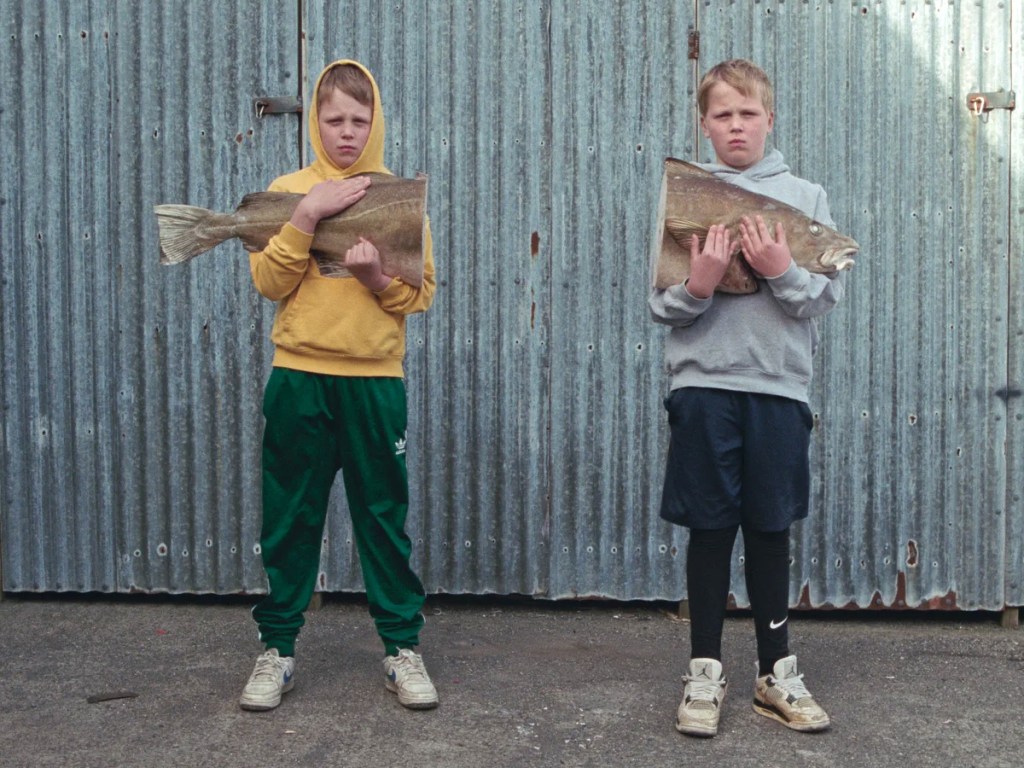
My pick from this year’s Nordic Film Festival was a bittersweet drama about a fractured family, both earthy and strange, unfolding against the haunting Icelandic landscape.
I adored writer-director Hlynur Pálmason’s previous feature Godland, an icy but compelling exploration of nature, history and religion in 19th-century Iceland. The subject matter of The Love That Remains is more intimate and modest, handled with a lighter, tragicomic touch. The film may not have hit me with the same force, but it still felt unique and quirky enough to leave a lingering trace of its own. Plus, just like Godland, it features an adorable performance from a charismatic Icelandic sheepdog portraying Panda, the boisterous pet inseparable from the fabric of family life.
Mostly plotless, the film charts a year in the life of a family living through the amicable separation of the parents, Magnús and Anna. Magnús (or Maggi as he’s called) spends long gruelling hours working offshore on a fishing trawler, with the recent divorce leaving him adrift at sea in both literal and emotional sense; he struggles with isolation and the loss of his role in the family. Anna is an artist, working with the rusting metal to create vast tapestries with patterns in ochre and red. She seems more settled of the two, though she’s frustrated with the lack of progress in her art career, especially after a comical visit from a pompous, talkative art dealer who, after boring Anna senseless, doesn’t have a place for her art in his gallery after all.
Maggi and Anna still haven’t worked out the boundaries of their new relationship, which remain rather porous. They spend a lot of time together in the family’s rural home, looking after their three children, spending days in nature on walks, foraging expeditions and picnics. The children are not sure of what’s going on with mum and dad, wondering at one point if their parents still have sex. From time to time, Maggi does ask Anna for sex, and you get an impression that she did indulge him in the past, though she’s now firm on him not staying around for too long.
The movie plays out as a series of carefully composed vignettes, some warm and winsome, some sad and melancholy, and some that are just plain surreal. One nightmarish scene that I can only describe as Revenge of the Giant Rooster had some of the most hilarious and disturbing imagery I’ve seen all year. Pálmason is clearly fascinated with the passage of time and change of seasons, coming through most vividly in the striking still tableaus featuring the scarecrow knight, used as an archery target by the children. Much later in the film, the knight comes to embody wounds and resilience in yet another scene with magical realism.
The Love That Remains does have a touch of Nordic chilliness about it and might come off as too emotionally distant for some, but I found it very easy to become engrossed in its hypnotic rhythms, simple daily rituals and natural beauty. It’s a fascinating peek into a lifestyle so far removed from my own urban existence.
P.S. Sometimes when watching a movie, you end up mentally trying on the characters’ way of life, and here I found myself wondering if I’d want the kind of rural life portrayed onscreen. It’s true that, in the recent years, I feel like I get more out of nature than I ever have before, but I still don’t think I’m ready to abandon the cultural life of a big city. The time for sea change or tree change hasn’t come yet, though I can imagine myself being pulled further that way the older I get.

