

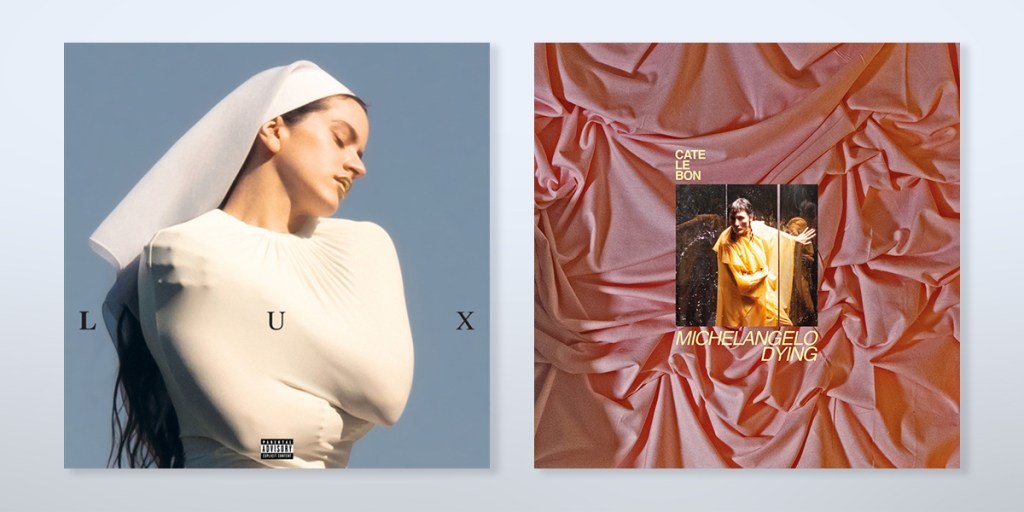
I’ve been in a mood for some artsy, experimental avant-pop. These two albums are not musically alike, but they definitely share the same adventurous spirit.
Rosalía
Lux
Even by Rosalía’s own lofty standards, the fourth album from the Spanish singer is wildly ambitious: arranged in four movements, sung in 13 different languages including Ukrainian and Japanese, recorded with the London Symphony Orchestra, and taking inspiration from the classical music, female Catholic saints and spiritual themes. This may all sound like a homework assignment or too grandiose for its own good, but for my own part I loved the album even without digging into its backstory and creative process prior. I’m embarrassed to say that I didn’t even pick up on the multilingual aspect; Rosalía’s quivering vocals, steeped in classical flamenco, always felt to me more like another musical instrument.
I would say that Lux is a tad frontloaded, with a brilliant first half and a very good second half that doesn’t quite match what comes before. At present, most of my favourite moments happen early on. The opener Sexo, Violencia y Llantas begins with soft yet frantic piano, before exploding into buzzing electronics and swelling choir. In Reliquia, Rosalía sings over playful, uplifting strings, while Mio Cristo Piange Diamanti (My Christ Cries Diamonds – what a gorgeous title) is a pure showcase of her agile, expressive vocals.
Berghain is the album’s operatic peak, with monumental orchestral arrangements, thundering choir reminiscent of Carl Orff’s Carmina Burana, and Rosalía going full soprano. As if that wasn’t enough, Bjork pops up for a guest spot, and a foul-mouthed chant from Yves Tumor takes the track from divine to obscene. La Perla is a deceptively charming waltz, that is until a closer look at the lyrics reveals a lacerating takedown of a nasty manipulative ex-lover.
The back half has a few tracks I’m lukewarm on, kinda like the slower parts of your favourite classical symphonies that you sit through to get to the good stuff. It does have the utterly infectious La Rumba del Perdón, with joyful flamenco handclaps and guest flamenco singers adding an earthy touch. Overall, Lux is a unique, immensely rich and impressive work as Rosalía continues to push the boundaries of pop music, and I can’t even imagine where her ambition will go next.
Cate Le Bon
Michelangelo Dying
I never heard of Cate Le Bon until this year, but Wikipedia tells me that the Welsh singer-songwriter-producer has been making music for over fifteen years now. It’s funny, I’m long used to the idea that I will never get to read every single great novel that exists, but when it comes to music, I can still feel sad at the thought of only ever experiencing a sliver of great stuff out there.
Michelangelo Dying is Le Bon’s seventh album and was apparently inspired by the demise of her long-term relationship. To be honest, I’d never have guessed that I was listening to a break-up album without the research, as the emotion here comes mainly through the music rather than Le Bon’s abstract impressionistic lyrics or her chilly, aloof vocals that sometimes slip into speak-singing. Usually, the vocals can be a make-or-break thing for me, and it’s not often that I’m drawn to an artist primarily for their music.
The moody, psychedelic and lush sound of the album is quite wonderful to get lost in, awash in delightfully eccentric textures and at times so densely layered that it’s hard to distinguish the individual instruments. It does create a feeling of sameness, as if every song has been dipped into the same murky sauce, but it is surprisingly not wearying. It helps that Le Bon has an ear for a good poppy hook, with Mother of Riches easily the catchiest and prettiest song. Also, I can tell that there’s quite a bit of saxophone here, which is always a good thing in my book.

