
I enjoyed this very English take on post-apocalyptic survival, even though the story turned out to be quite different to what I expected.
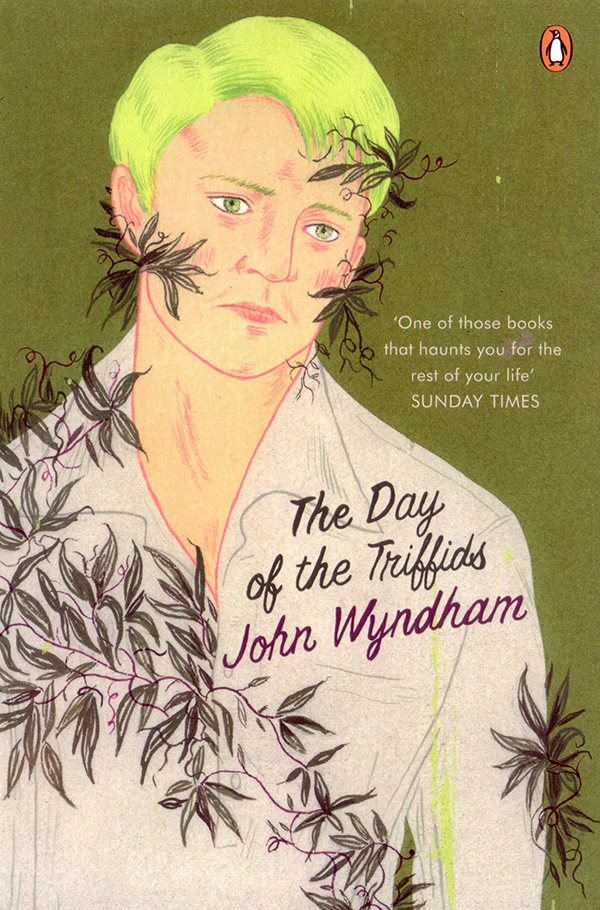
This is the second John Wyndham novel I read after The Midwich Cuckoos, and since that book dealt with an alien invasion, I anticipated something similar, something like Killer Plants From Outer Space. The biggest surprise of The Day of the Triffids is how long the triffids remain on the periphery of the story, and how long it takes for them to become an existential threat.
The origin of the triffids is left mysterious, but it’s hinted that these carnivorous plants, over two metres tall when fully grown, are a result of biological experiments gone awry (with Cold War as a setting, of course it’s the fault of those damn Soviets). It doesn’t take long for them to spread and pop up in ordinary suburban English gardens, and for people to notice their strange and alarming aspects. One is their ability to sting and potentially kill a person with a single blow of a poisonous whip-like stalk. Even more unnerving is the discovery that the triffids are able to detach their roots from the ground and move around at a decent walking pace. Eventually, the public interest and hysteria die down as most of the triffids are made harmless, and they turn into a big business, farmed for the production of superior oil.
Contrary to my expectations, the triffids have nothing to do with the catastrophic event that ends civilisation as we know it, but in a way they save the life of the novel’s protagonist, Bill Mason, a biologist and triffid expert. A vicious sting lands Bill in a hospital with bandages over his eyes, and so he’s one of the few people missing out on a global event, a most spectacular meteor shower that lights up the sky to everyone’s delight. The next day, Bill wakes up to eerie silence. Once he works up the courage to remove his bandages, he realises that the cosmic event the night prior left everyone who witnessed it with permanent blindness.
Bill makes it to central London, where he finds masses of sightless people wandering around, and only a handful of sighted survivors, including a young woman named Josella. Bill faces the ethical dilemmas of your average decent everyman caught in a societal collapse: who to help, who to save, and whether his efforts to help only prolong the suffering. He can’t quite let go of the old civilised values, but he must change and adapt if he is to survive and find safe haven with Josella and others.
This is perhaps not the bleakest and scariest post-apocalyptic world there is, but it’s still pretty grim. There are gangs of blind people desperate to catch any sighted person so that they can force them into servitude. There is also growing competition between the factions of survivors, all with their own ideas of how a human society should be organised. And then there are those pesky giant flesh-eating plants, multiplying in the wild and growing bold. Humanity is not completely doomed yet, but it becomes obvious that the triffids will make the task of rebuilding that much harder.
This is a very familiar scenario, seen in films like 28 Days Later among many others, but Wyndham’s droll, measured and thoughtful writing makes it distinctive, as does the unsettling scenario of the whole world going blind. Though I wouldn’t describe the novel as cosy, you could only hope that the real-life cataclysm would be met with this much stiff upper lip, and logical, sensible discussions on how the humanity must adjust to the new world order.
The novel may stay away from the more gruesome descriptions, yet it doesn’t lack haunting scenes or a deep sense of loss. There’s a wonderful and poignant scene fairly early on that stuck with me, in which Bill and Josella say goodbye to their old world in a luxurious London apartment. Similar to The Midwich Cuckoos, character work doesn’t really stand out here, but the romantic subplot does add some heart and urgency to the story, even if it’s the kind of reserved romance found in Agatha Christie novels.

