

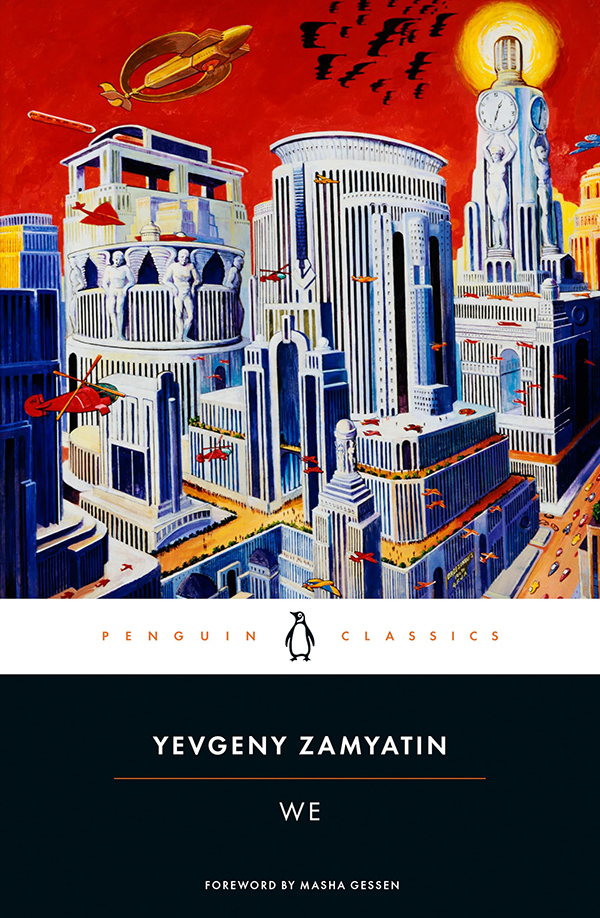
1984 might be the definitive work of the dystopian genre, but it was in turn influenced by this lesser-known Russian novel written in the early 1920s, the proper granddaddy of the modern dystopian literature.
For a book of major significance and influence, We is relatively obscure and I haven’t even heard of it until very recently. Originally published in New York after being smuggled out of the country of its origin, We wasn’t published in Soviet Russia until 1988, three years before the dissolution of the Soviet Union. Zamyatin doesn’t draw direct parallels with the contemporary Soviet politics in his novel, but I could easily see why Soviet authorities would consider it ideologically unacceptable.
The novel is a series of diary entries written by our protagonist, a space engineer known only as D-503. He is the citizen of OneState, a totalitarian society built on the principles of logic, mathematical precision and uniformity, isolated from the messy natural world by a giant glass wall. It is ruled by the ominous figure called The Benefactor, who is re-elected annually by an unanimous vote from the entire population. Everyone inside OneState is sustained by synthetic food, wears identical uniform, and lives in glass houses, under the constant surveillance by the Guardians, pretty much the state police.
Life in OneState is regulated to the minute by the Table of Hours, which allows a couple of Personal Hours per day. They’re usually spent outside marching in fours to the sounds of OneState anthem, or behind drawn curtains enjoying rationed sex (the only occasion when anyone can have some privacy). Every now and then, the inhabitants gather around to watch an execution of Numbers who have somehow blasphemed against the state.
D-503 believes that he lives in the greatest society that ever existed, and describes it in the most glowing terms, in hope that one day his diaries will reach and educate people on distant planets. He is immensely proud of being the chief engineer in charge of Integral, the first spaceship intended to bring the word of the Benefactor to the other worlds, by force if necessary. The secret of happiness, according to OneState, is that happiness and freedom are incompatible – just look at what happened to Adam and Eve when they were driven into the freedom of the wilderness.
D-503 is committed to absolute honesty, including the period when his ordered existence is slowly unravelled by an encounter with an unusually alluring woman, I-333. She breaks the rules, drinks and smokes, and is brazenly confident that D-503 will do anything she says and never report her to the Guardians. I-333 is correct: though she appalls him, D-503 cannot overcome his attraction, and is pulled deeper and deeper into her transgressive, rebellious world. To his horror, he seems to be developing something close to a soul. Love would later become a popular driving force in the dystopian fiction, a chaotic event that profoundly alters the protagonists’ feelings towards their own societies.
I found myself agreeing with George Orwell who praised We overall but noted its weak and episodic plot. To be fair, the fragmented feel of the story can be chalked up to the increasingly feverish state of D-503’s splintering mind as he struggles with his new feelings. His voice is the best thing about the book, it’s poetic, vivid and exuberant, whether he sings praises of OneState or writes in detail about his own confusion and desperation. This frenzied style can sometimes feel disorienting, but it has a great sense of urgency and I loved how visceral and immersive the writing was. It completely dispels the notion that OneState has managed to iron out all passion out of human nature. In fact, individual passionate feelings are all around D-503, even in characters who do not dream of bringing their society down.
As much as I liked We, it does feel somewhat dated where 1984 still feels relevant and terrifying. Perhaps, after the real totalitarian regimes of the 20th century, the notion of a repressive society built on mechanical efficiency and rigid mathematical formulas, tyranny of order if you like, is rather quaint. There’s also a whimsical feeling to the novel that makes even its most horrific moments dreamlike and unreal. But that’s not to dismiss the things it has to say about the modern industrial society, the cycle of revolutions and the nature of authoritarianism.

