

As a fan of Christopher Nolan, it pains me to say that I can’t recall the last time I was this disengaged at the cinema. For me, his take on Homer’s epic was mostly a slog, with some redeeming aspects.
This was especially disappointing coming on the heels of Oppenheimer, Nolan’s magnum opus and for my money the crowning achievement of his career. It boggles my mind that Nolan made a three-hour talkfest about atomic physics and committee hearings feel like a thrilling white-knuckled ride, and then proceeded to drain life and excitement from one of the greatest adventure tales in all human history.
Back in my teens, I was obsessed with Greek mythology, and though I never properly read The Odyssey, I loved the re-telling of Odysseus’ 10-year journey back to his home of Ithaca after another decade spent fighting in the Trojan War. When I heard that Christopher Nolan was bringing The Odyssey to the biggest screen, I was both excited and slightly taken aback. For a director with a thoroughly modern and grounded sensibility, myth and fantasy are as far from a natural wheelhouse as it can get. How would Nolan deal with this tale of gods and monsters? I wasn’t at all sure, but I was more than eager to give him a chance.
I tend to be lenient when it comes to film adaptations, and I was likewise willing to accept Nolan’s interpretation of The Odyssey on its own terms. The promos, publicity and controversies prior to the release prepared me for a very contemporary take with everything it implies these days – diverse cast, current day morality superimposed over a tale from another time, a deconstructed hero, stronger feminist flavour, all in addition to modern vernacular and American accents. I was fine to roll with all of that, but what I didn’t see coming was how dull and cramped this supposed epic was. Uninspiring trailers can be deceptive, but in this case the film absolutely lives up to the trailers.
This could be a record of how fast I checked out of a movie. I felt my eyes glazing over during the first ten or so minutes set in Ithaca, where, in Odysseus’ absence, his son Telemachus (Tom Holland) and wife Penelope (Anne Hathaway) are fending off hordes of suitors set on marrying Penelope and taking the throne. These scenes are clinical exposition dumps rather than conversations between real people; Nolan made exposition work in his other films without it coming off sterile, but here I felt the tedium set in right off the bat, and the movie never truly recovered afterwards.
I also suddenly found myself in sync with the people who hated the rapid editing and pacing in Oppenheimer. It didn’t bother me in that film, but here it killed nearly all of my emotional investment in the characters and story. The introductory vignettes, including flashbacks to the Trojan War and Odysseus’ present-day stay with sea nymph Calypso (Charlize Theron), whizzed by before I could get any feel of the characters and their relationships. I felt nothing when Odysseus’ crew got decimated on this island or another, and I felt nothing during various reunion scenes in the third act. One of the most moving moments in the original story happens when Odysseus is recognised by his old faithful dog. I can’t think of a more reliable way to pull at the heartstrings than a dying pet, but even this scene is so rushed it leaves no impact.
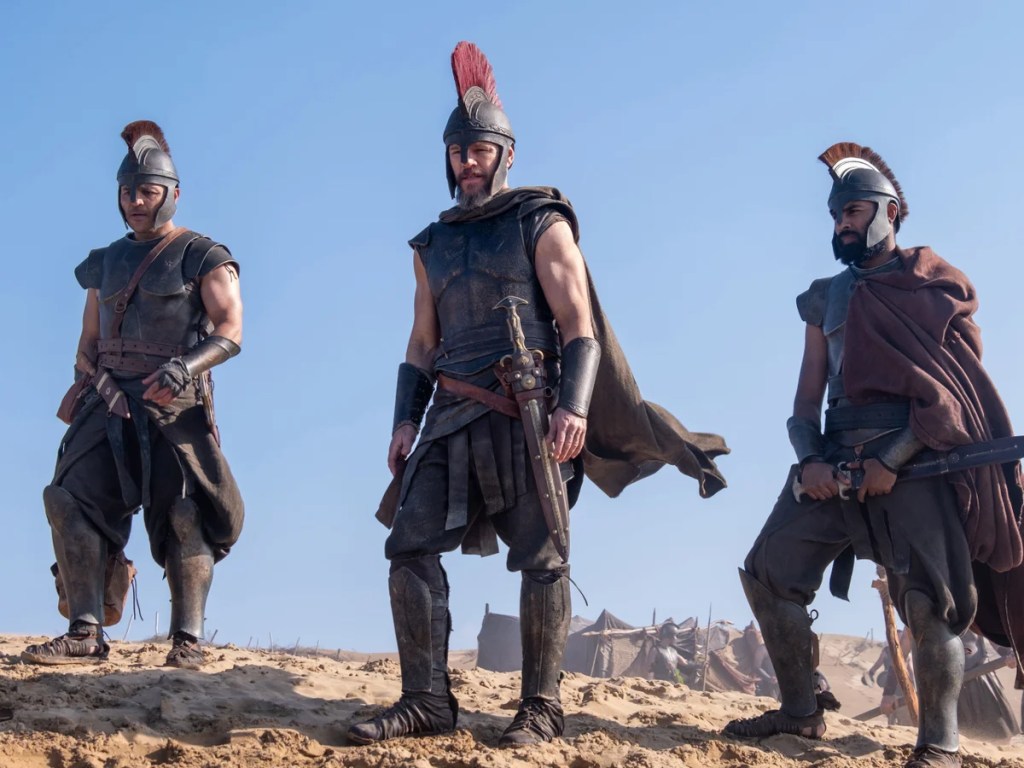
I expected a more grounded approach from Nolan, but he seems to swing between gritty authenticity and more stylised take without fully committing to either. Apparently he put a lot of effort into building a genuine seaworthy ship, but when the imposing Greek king Agamemnon shows up in his outlandish black armour he looks like Ancient Greece’s own Batman. Historically accurate or not, it’s one of the few visually memorable things in the film, so why not just embrace style?
Nolan’s take on the fantastical elements was likewise frustrating and felt like the worst of both worlds. He largely dispenses with gods, with only Athena taking on a proper human form which may or may not be a mere figment of Odysseus’ imagination. The mythical creatures that are present, including one-eyed Cyclops, sweet-singing sirens and sea monster Scylla, are all rather humdrum and in case of sirens barely visible. Only a couple of supernatural scenes really worked for me. One is the imaginative and gruesome body horror sequence set in the house of sorceress Circe (Samantha Morton, whose performance cuts through the drabness and belongs in a much better movie). Another is a wonderfully eerie and atmospheric side trip to the dark underworld, where Odysseus must summon the shades of the dead.
The beautiful natural locations are overall a major saving grace, but they don’t prevent the film from feeling weirdly small. Nevermind cinematic epics like The Lord of the Rings or Lawrence of Arabia, I felt greater awe and wonder watching fantasy series like Game of Thrones on my home TV. The poorly lit interiors feel cramped, and the sack of Troy is well-shot but feels underwhelming in scale; this is where Nolan’s famous aversion to CGI probably lets him down. It is also rather bloodless. Considering how important the war atrocities committed in Troy are to Odysseus’ character and the greater point of the story, the film hardly makes full use of its R rating.
A memorable iconic score is a huge part of Nolan’s films – I don’t think I’d cut Interstellar as much slack without Hans Zimmer’s celestial spine-tingling music. Sadly, after his stellar work in Oppenheimer I was shocked with how unremarkable Ludwig Göransson’s score was in The Odyssey, all I could remember was a lot of thumping repetitive drums. Speaking of repetitive, if I was in the same room with Travis Scott’s bard, I would demand that the guards confiscate his staff that he used to tap the floor after nearly every – single – damn – word.
You rarely get a bad performance in a Nolan film and it’s also true for The Odyssey, but more than half of its cast simply don’t register much. I keep coming back to Oppenheimer, but that film was simply stacked top to bottom with strong memorable turns, no matter the screen time. There were some performances I enjoyed. Despite my initial reservations, Matt Damon is rock solid as Odysseus, bringing weariness and gravitas to the role. His hero is not Homer’s wily and arrogant Odysseus, grappling with PTSD rather than hubris, however Damon embodies this version well. I also liked John Leguizamo as Odysseus’ faithful servant, and Anne Hathaway’s poised, maternal and resilient Penelope, who also cuts a fine figure in her elegant robes; along with Agamemnon and the Trojan horse she is the only fabulous-looking character in the movie.
This was my first time seeing Tom Holland onscreen since I haven’t watched any of his Spider-Man films; all I can say is that he makes a serviceable Telemachus. Robert Pattinson is the only actor having fun as Penelope’s slimy scheming suitor, but his villainy wears thin after a while. The rest of the cast, including Charlize Theron, Jon Bernthal, Lupita Nyong’o, Zendaya as Athena, Elliot Page in a small but crucial role as Sinon, are just not given much to do.
It makes me sad to think that it could take decades until the next big screen adaptation of The Odyssey. I do have a place in my heart for massively flawed Nolan movies like Interstellar, I doubt that The Odyssey will ever join it.

