

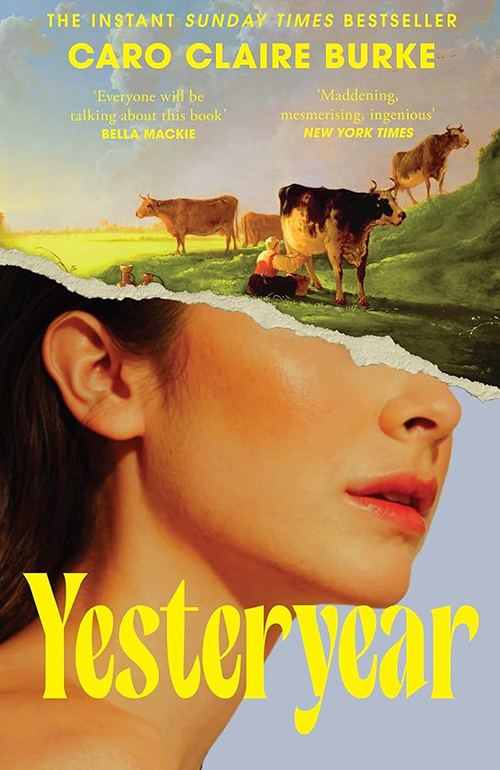
I had fun with this buzzy tradwife thriller, but it’s fair to say that it entertained and frustrated me in equal measure.
You have to admit that the high-concept premise of Burke’s debut novel is so perfectly designed to grab you, it might as well have been concocted in a lab. Meet Natalie, a beautiful Christian wife and mother of five children, with sixth on the way. She lives in an adorable rustic farmhouse with her handsome cowboy husband Caleb, and sells her traditional lifestyle, raw milk, fresh eggs, wholesome sourdough recipes and all, to the millions of social media followers. They don’t need to know that Natalie’s charmed life is not achievable without her husband’s family money, and a small army of nannies, producers and seasonal workers all doing their parts behind the scenes.
One morning, Natalie wakes up shivering beneath a thin quilt, in a life that’s familiar yet completely off. Her house looks like a drab, dilapidated 19th-century version of itself, warmed by the fire rather than electricity. Her children are not her children, and her soft feckless husband has transformed into a cold-eyed patriarch who won’t hesitate to hit her. Has she really time-travelled to 1855, as a freshly notched entry on the door seems to suggest? Is she a victim of an elaborate hoax, an unwitting participant in a sadistic TV show? Is this a test from God?
Though a genius hook, I felt that the mystery was ultimately to the novel’s detriment. I never actively try to figure out things in a story, preferring instead to more or less go with the flow. Here, a telling detail early on gave me a fairly good idea of what was really going on. When it did arrive, the story twist was somehow both predictable and still absolutely bonkers. It also made me think less of the old-timey chapters in retrospect. In the end, they’re not there to make a point you think the book is making, when it forces its anti-heroine to experience the harsh reality of the olden days.
(I don’t claim to be an expert on tradwives, but my general impression is that they tend to romanticise the gender roles and aesthetics of the 1950s rather than 1850s, and don’t explicitly reject modern technology. It makes more sense that some women would be drawn to the period when housewives already had vacuum cleaners and automatic washing machines, and were freed from the back-breaking labour of their female ancestors. I suppose Burke picked the more distant century in order to inflict greater physical hardship and discomfort on Natalie.)
The real meat of the story is in the flashbacks to Natalie’s past, from her small town conservative upbringing, to her unhappy and alienating time at Harvard, to her marriage to Caleb, a scion of a wealthy, politically prominent family. Natalie is dismayed when Caleb reveals himself to be a dull, dim-witted man with zero aspirations, and she doesn’t exactly take to motherhood either. Making Caleb into a respectable husband and channeling her own ambition and competency becomes Natalie’s project, and a solution arrives when the couple acquire Yesteryear Ranch in rural Idaho.
We spend the entire book inside Natalie’s head, and paradoxically, I found Natalie the biggest strength and the biggest weakness of Yesteryear. She’s unlikable, cruel and vindictive, and seems to regard other people in her life mostly as props, including her children. At the same time, her narration is biting, often hilarious, and makes the book insanely readable as it zips along. Though you wouldn’t want to know them in real life, there can be something very magnetic about truly appalling fictional characters, who can be mean and amusing at the same time.
Performance is one of the major themes of Yesteryear, and the book is at its best and sharpest when it skewers the social media influencers and the artifice beneath the supposedly authentic content. For Natalie, who lacks meaningful friendships throughout her life and doesn’t seem to like people in general, the performative nature of what she does creates an online persona that has little to do with the real, sharp-edged Natalie. There’s also some pointed exploration of how children fit into the influencer lifestyle, and the fact that they can’t truly consent to social media exposure.
My biggest issue with Natalie is that she is so obviously written by a modern progressive who has no real interest in inhabiting the mind of somebody with beliefs diametrically opposed to her own. There are flashes when Natalie makes bitter remarks about the society and women that would hardly be uttered by someone immersed in religious traditionalism, and make her sound like the author’s mouthpiece. I never felt that she was speaking from inside her faith, but rather from the outside looking in. This would make sense if Natalie abandoned her religion, or was someone who pretended to be a believer for cynical reasons, but she is neither. She is also written as blandly, generically Christian, when the specificity of any particular denomination would be of great importance to the real believer.
In the end, Burke clearly felt like she had a lot to say about a great deal of things, including motherhood, politics and manosphere, but hasn’t given them all equal care and detail beyond the very obvious and cartoonish. Still, for all its flaws, Yesteryear was simply too damn compulsive with too much delicious satirical bite for me to dismiss altogether.

