

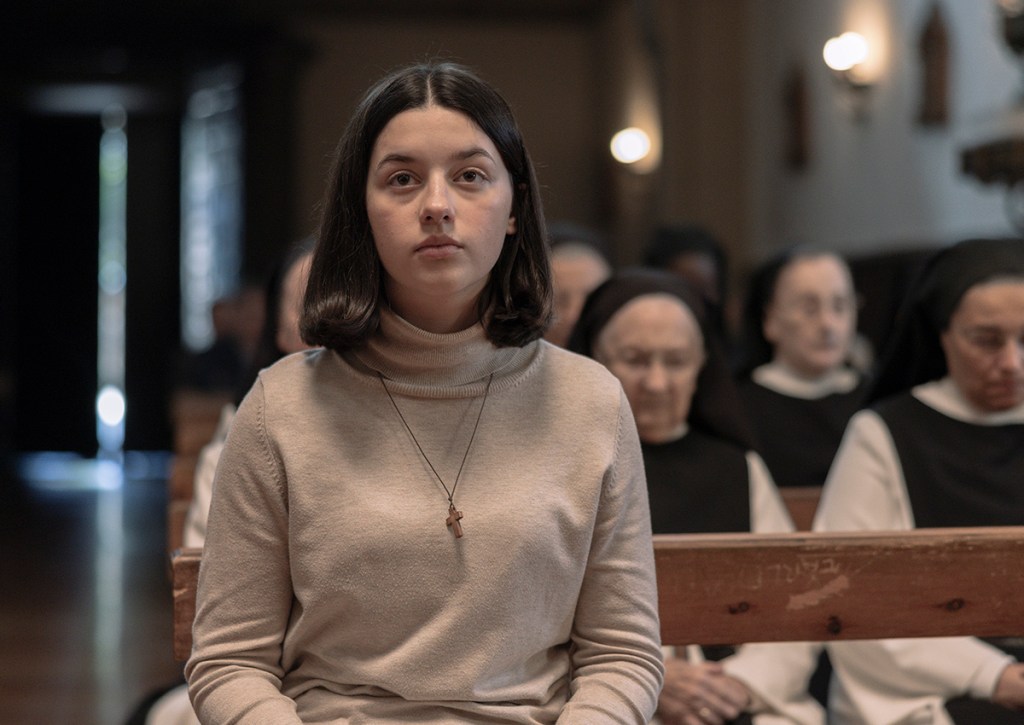
A pick from the Spanish & Latin American Film Festival, this quiet, thoughtful and engaging family drama about religious calling is also an unusual coming-of-age story.
On the long list of shocking things a teenage girl might do, becoming a cloistered nun is probably not the first thing that comes to mind. Yet this is the decision of Ainara (Blanca Soroa), a bright 17-year-old studying at a Catholic school in Bilbao. It’s a curious scenario for your average modern middle-class family to confront, even in Catholic Spain, and it definitely caught my attention. Stories about young people in religious environments often centre around them breaking away; I was intrigued by a film that does the opposite.
The bombshell lands when Ainara comes home to her family: her widowed father Iñaki, two mischievous younger sisters, grandmother Lila and aunt Maite, who acts as a surrogate mother and trusted confidant to the girls. There are already simmering tensions, involving a massive loan that Iñaki has taken to renovate his restaurant, and Maite’s sinking marriage. Initially, Ainara tells her family that she would like to return to the convent for a trial period of “religious discernment”, but soon it dawns on everybody that this could potentially mean a radical choice of life behind the convent walls.
The film makes an inspired choice by leaving Ainara a still, somewhat elusive centre around which the drama swirls. She is not without questions and doubts, and there’s an earthly temptation in the shape of a cute boy from the school choir, but all in all Ainara moves towards her destination with clarity and quiet determination. Blanca Soroa is perfectly cast as an idealistic, pensive teenager with the soulful face of young Virgin Mary, and she more than rises to the occasion when a climactic spiritual crisis demands extra intensity from her.
Ainara’s family on the other hand is left reeling. Iñaki takes a position that his daughter must make her own choices, though one senses that Ainara’s emotionally distant father simply finds it easiest not to interrogate her decision. Meanwhile, outspoken and fiercely secular Maite is horrified that Ainara would miss out on university and travel, sex and romance, and other worldly experiences. She also questions the motivations behind this religious turn: is it merely a mix of teenage hormones and charismatic influence of Ainara’s guidance counselor and priest? Does it stem from Ainara losing her mother at a young age? Patricia López Arnaiz as Maite is an incredible, intense presence and never a mere antagonist, vacillating between rational concern and strong emotion that is at least partly rooted in her own personal troubles.
What I appreciated the most about Sundays is the sensitive treatment of Ainara’s life-changing decision, and the even-handed approach given to different points of view, leaving it up to the audience to make up their mind about the characters’ choices. It doesn’t romanticise the austere convent life, but it doesn’t portray it in a negative light either. For me, it also highlighted the sheer gulf between believers and non-believers; as the convent’s Mother Superior puts it, faith is something you either have or you don’t.
I also loved the bittersweet ending, the rowdy comedic energy of Ainara’s siblings, and a beautiful choral rendition of Nick Cave’s Into My Arms – who knew that Spanish religious schools include Nick Cave in their repertoire?
P.S. The young handsome priest reminded me of Father Peter from Derry Girls, though he doesn’t have the same hilarious dynamic with Mother Superior as Father Peter does with Sister Michael. Now I feel like another Derry Girls re-watch.

