

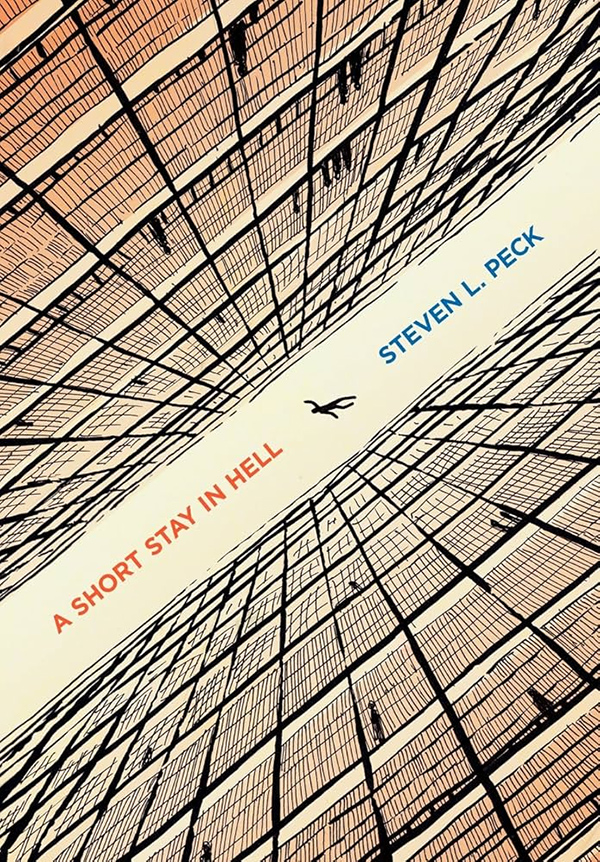
This flimsy but intriguing novella mixes horror and philosophy for a mind-bending take on the afterlife. I enjoyed its ideas if maybe not the execution.
Soren Johannson, a devout Mormon, dies of brain cancer at the age of forty-five. Good news: God and afterlife do in fact exist. Bad news: a rather sassy and sarcastic demon informs him that Soren had picked a wrong religion. Zoroastrianism is the one true faith, and everyone who wasn’t a believer is destined for a customised hell.
Soren’s hell is based on The Library of Babel, a short story by Jorge Luis Borges, which envisions an incomprehensibly vast library where every possible book that could be written exists. Take a standard English language keyboard, and imagine every possible combination of letters, numbers and symbols that can fill a book that’s about four hundred pages long. It’s not infinite, but it might as well be. Now imagine that, in order to escape this hell, you must find a book that tells your complete life story, with no spelling mistakes. It would be like trying to locate a particular speck of dust in the universe.
The novella is not very convincing when it comes to the overall religious framework. Peck seems to have pulled Zoroastrianism out of a hat at random, because absolutely nothing about this faith informs anything in the book, save for the idea that punishment is not permanent. He does set out the rules for this bookish hell. Just as in life, there’s a 24-hour day, and everything resets in the morning: books not in your possession are returned to their shelves, and if you happen to die you are restored to life like a video game character. There are rooms with beds and restrooms at regular intervals, and kiosks that will serve any food or drink you name. You can jump over the railing and fall to the bottom, but you’ll be falling for a very, very long time.
At first, this hell doesn’t seem so bad. There are no rivers of fire and demons poking you with pitchforks. You are sheltered and fed, you’re forever young and in your peak physical shape even if you died in your nineties. There’s even company to be found in your fellow denizens of hell, though Soren soon detects a certain monotony in meeting only white Americans from around his own time period. Best of all, there’s a glimmer of hope that you can make it to heaven if you just apply yourself.
What Soren and his companions don’t realise is the sheer enormity of their task, and that they’re about to be crushed by the billions and billions of years spent in the library. Essentially, most of the story told here is of Soren’s early years, when he can still find fulfillment in other people. He becomes a part of a university, falls in love, and sees the rise of a horrifying torture cult.
A Short Stay in Hell is easy to read, even if Peck’s ideas are much stronger than his prose; I raced through it in a couple of hours. There is however a skeletal, half-baked feel to the whole thing, as if this novella was a mere synopsis for a richer, more satisfying full novel that never got written. It races through the events so fast that a crucial romantic relationship, clearly the intended emotional heart of the story, comes off like the lamest insta-romance with no weight or substance.
Still, this vision of hell – two infinite stacks separated by a great chasm, shelves full of books filled with gibberish – is so horribly compelling and so full of existential dread that I don’t think I’ll ever forget it. At the very least, I’m grateful to the book for giving me a truly unique scenario to chew over.

