

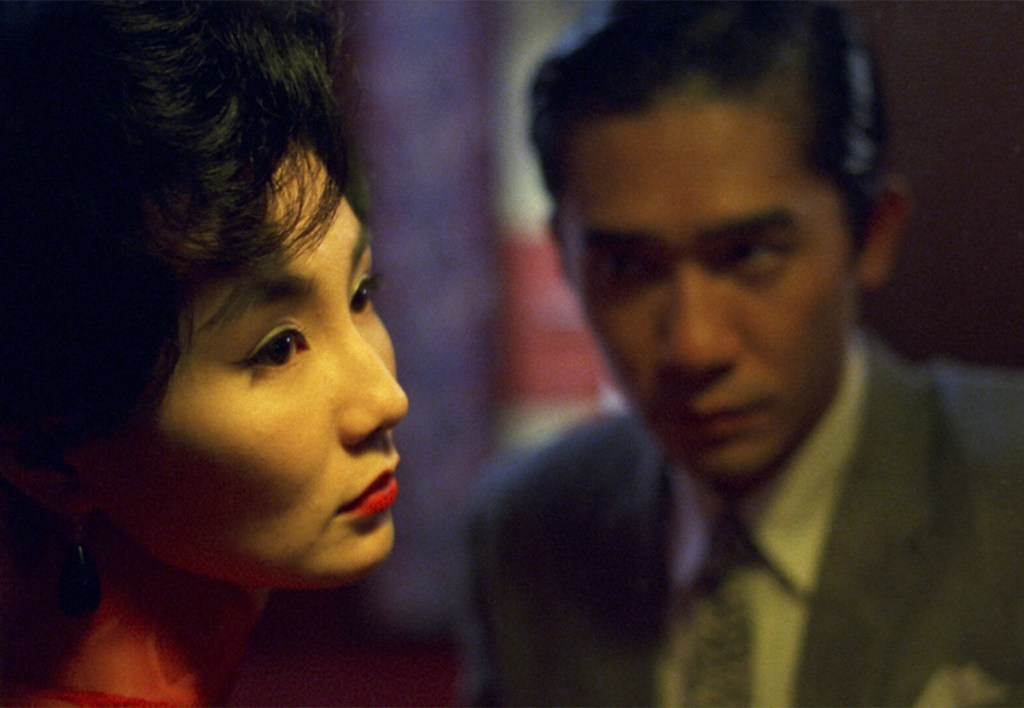
After a long break, I was back at the Astor Theatre for this sumptuous, melancholy romantic drama about unconsummated love in the 1960s Hong Kong.
Some of the best romantic stories are about a romance that never was. This year’s Past Lives was a gorgeous new addition to this bittersweet tradition, and after forever meaning to catch up with In the Mood for Love, I finally got a chance to see it at the cinema. This sensual, visually ravishing 2000 film from writer-director Wong Kar-wai really does deserve a big-screen watch.
The year is 1962, and in British Hong Kong, a married man and a married woman rent rooms next to each other, in an apartment block so cramped the furniture movers are getting confused which apartment belongs to who. The man is Chow Mo-wan (Tony Leung), a local journalist, the woman is Su Li-Zhen (Maggie Cheung), who works as a secretary.
Chow and Su treat each other cordially without going beyond the basic requirement for neighbours, but they are drawn closer when they realise, at the same time, that their often-absent spouses are having an affair with each other. Bound together by their feelings of hurt and betrayal, they embark on a secretive, ambiguous liaison of their own, without ever crossing the line into sexual denouement. “We will never be like them,” Su’s character says resolutely at one point. At first, they play pretend at being each other’s spouses, trying to understand how the affair came to be, but with time, feelings sneak up on both despite themselves.
With the plot kept to a minimum, In the Mood For Love is an artful mood piece about fleeting moments, evoking the forever gone ambience of Hong Kong in the 1960s. At first glance there is not much glamour to living in a tiny apartment with a noisy communal kitchen. However Wong Kar-wai’s film is an intoxicating, noirish world of dark streets, rich saturated colours, crumbling textures that feel almost tactile, cigarette smoke that unfurls sensuously, breathtaking floral patterns of Su’s silk dresses and wallpapers of shabby-chic apartments, and sultry, nostalgic soundtrack. The camera often turns voyeuristic, spying on the characters through the windows and reflections in the mirror.
Intriguingly, Chow and Su’s significant others are kept almost completely out of the picture (the film won’t even show their faces), so the movie remains a duet, with neighbours and friends popping up now and then for some comic relief. As a couple, Leung and Cheung are utterly alluring; he with a sensitive, appealingly boyish face, she a stunningly beautiful, willowy presence. Whether at work or going out to get noodles for dinner, Su always looks impossibly glamorous in her figure-hugging dresses, her hair always up in an impeccable do. The camera just can’t resist following her around as she sashays down the stairs and along the corridors.
The characters’ emotional reserve and strong sense of morality leaves the romance slowly simmering just beneath the surface. To a modern, individualist Western eye, Chow and Su might look like a pair who are too polite and repressed to go for what they truly desire, but I’m pretty sure that the film invites the viewer to find nobility in their restraint and self-denial, despite the regret at lost chances. It also adds more enigma to the relationship with the suggestive scenes that could be re-enactments of their adulterous spouses, wishful thinking, or something that actually happened.
I’m glad that I finally got to see this potent story of love and longing. In a way it’s probably for the best that I put off seeing it for years, until I myself reached an age where I could appreciate its sad, delicate beauty more than I would as a twenty-year-old.
 yggdrasille.com