

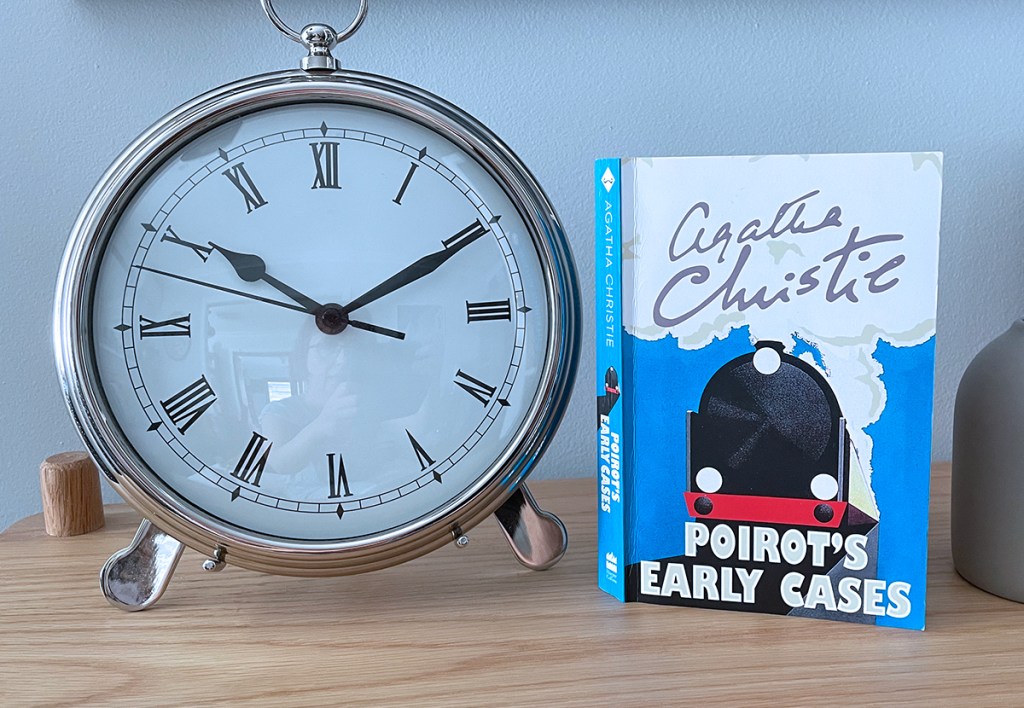
The last short story collection on my Agatha Christie Challenge list is an enjoyable selection of early cases that established Poirot’s professional reputation as (probably) the best detective in the world.
I didn’t expect this book to have any kind of framework, but early on it’s explained that all eighteen cases are meant to be hand-picked by Poirot’s friend Captain Arthur Hastings, who has a first-hand knowledge of most of them. Not to be mean to Hastings, but it’s entertaining to try and imagine what other characters might think of his tagging along with Poirot for no discernible good reason. In one of the stories, Poirot tells a hesitant witness that she may speak before him as if Hastings were a thing of no account, not there at all. He clearly means it as an expression of complete trust, but ouch!
The Affair at the Victory Ball recaps the basic facts about Poirot and the beginnings of his detective career in England, and is a fun start to the book. Six people attend a costume party, which ends with Harlequin found murdered and Columbine dead from a cocaine overdose. The use of the Commedia dell’Arte characters in this early short story is interesting since Christie would later channel her fascination into a series of short stories about the mysterious, elusive Mr Harley Quin.
The Adventure of the Clapham Cook is a rare foray into “lower class” crime, with Poirot more or less shamed into accepting the case by a woman who wants him to track down her missing cook, and accuses him of snobbery when he initially refuses. The story itself stretches believability perhaps, but it does have a refreshingly different premise.
The Third Floor Flat is another story with an unusual setup. After a night out, a young woman can’t find the keys to her apartment, so her two male friends attempt to get inside by the means of a coal lift. By accident, they enter a wrong flat first, and end up discovering the body of a woman hidden behind the curtains. Fortunately, Poirot happens to live in the same building and his investigation comes to a startling and rather inventive conclusion. One of the few stories not narrated by Hastings, it has a very different tone and feel.
The Chocolate Box, one of my personal favourites, likewise switches tone by having Poirot reminisce about a rare failure he suffered when he was a detective in his native Belgium. Until this collection I don’t think I’ve read a story told almost entirely from Poirot’s point of view. Here he investigates the unexpected death of a French deputy at the request of a family member who suspects foul play. Though Poirot is supremely confident about the identity of the murderer, he gets a big surprise in the end and explains to Hastings exactly where he went wrong, with an endearing mix of self-flagellation and arrogance.
Double Clue is a fairly slight mystery mostly notable for introducing the extravagant Countess Vera Rossakoff, the closest thing to a love interest Poirot ever had (another story has Poirot mentioning a young girl he was in love once, but it’s not clear whether he’s making it up or not). It also contains a major clue related to the Russian alphabet that was put to a much better use in Christie’s all-time classic Murder on the Orient Express.
In fact quite a few short stories were familiar, either because they were completely reworked and expanded into a novel or novella, or because Christie borrowed some of the plot and character elements in her later books. The Plymouth Express, in which a dead body of a woman is found onboard the train, became the basis for The Mystery of the Blue Train. I don’t rate that novel highly and the shorter version of the same story actually went down better, if only for its brevity. The Submarine Plans, a country house mystery about the stolen top secret plans of national significance, became The Incredible Theft. One major change in the later novella was dispensing with Hastings and his narration, which I have to say improved it. Poor useless Hastings!
Hastings was likewise absent from Murder in the Mews, one of Christie’s best novellas that was based on The Market Basing Mystery. This short story has a completely different setting and characters, but the solution is just as clever and highlights Poirot’s formidable powers of observation. How Does Your Garden Grow? is vaguely reminiscent of Dumb Witness, with a similar setup of Poirot receiving a letter from an old lady asking for help in a delicate family matter, only to find out that she has died. This short story also has some entertaining descriptions of Poirot’s uber-efficient secretary Miss Lemon.
This wraps up all of Christie’s short stories collections, with only four novels left to go! I might actually fulfil my New Year’s resolution and finish my Christie reviews by the end of 2023.

