

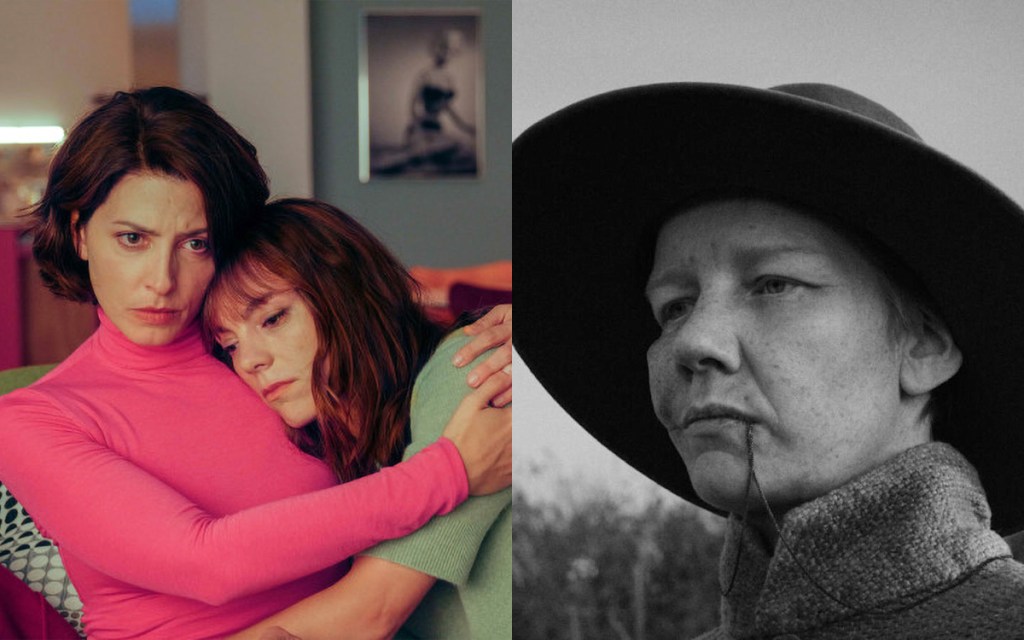
I saw a few films at this year’s MIFF and these were my favourites: the latest from Pedro Almodóvar and a striking gender-bending period drama with fabulous Sandra Hüller.
Pedro Almodóvar movies are such a pleasure to watch, and so is this nested, self-aware drama about the ethics of art and messy creative process. It might be too episodic and meandering for its own good, and it lacks the emotional resonance of his best films, but it was worth seeing for the melodrama, incredible female-centric cast and immaculate production design alone (all the splashes of primary hues and vibrant colour blocking make my heart sing).
It takes a while to register that you’re watching a movie within a movie. In 2004, Elsa (Bárbara Lennie) is a once-promising indie filmmaker now making living in commercial advertising. She lives with her younger boyfriend Bonifacio, a shy firefighter by day and a cheeky part-time stripper by night (I’ll say that he put on a far better show than a hen night I went to once). Elsa is not in a good place, wrestling with a new script, struggling with killer migraines and panic attacks after the death of her mother. Her friends are equally troubled: one is depressed after the death of her young son, another friend (bearing a striking resemblance to Anya Taylor-Joy) has a cheating husband she can’t bring herself to leave.
All of this is actually being imagined in the present day by an ageing film director Raúl (Leonardo Sbaraglia), a stand-in for Almodóvar who appears to give himself a playful yet lacerating dressing-down. Raúl is the God shaping Elsa’s story, shifting it this way and that depending on what happens in his own life. People close to Raúl end up being inserted into his autobiographical script, including his good friend and assistant Mónica, who is furious at him for feeding off people’s lives and traumas without their consent.
Mónica’s character and her brutally honest, gloves-off tirade during the climax is what ultimately gives the movie some belated real weight beyond its appealing moments. That’s not to downplay the many pleasures of these moments, the uniformly strong performances and a couple of achingly gorgeous musical interludes.
Sandra Hüller is fast becoming one of my favourite actresses working today, and she is outstanding in Rose, a tragic folktale brought onscreen with stark elegance and simplicity by an Austrian film director Markus Schleinzer. It’s a story of Rose, a woman in 17th-century Germany who is passing herself off as a man, apparently not based on any historical individual, but rather an amalgamation of several real-life cases.
As the story is told by an unseen narrator, Rose remains an enigma for much of the film, not given to emotional disclosure and personal confessions until very late. We meet her as a hardened former soldier with a face scarred by a bullet, who comes into a remote, tight-knit Protestant village to claim ownership of a derelict farmstead. The villagers are initially wary of the stranger, but Rose wins them over when she revitalises the land and kills a hostile bear with a well-aimed shot. She even manages to navigate a potential disaster after marrying Suzanna, the daughter of a prosperous neighbour, though the news of pregnancy from supposedly innocent and pious Suzanna comes as a massive shock.
There’s a shade of The Wife of Martin Guerre to this story of assumed identity, and you know from the start that Rose is bound for a grim ending. But what a beautiful downer it is, with arresting black-and-white cinematography and every shot composed with icy precision. It also locates a surprising amount of humour in Rose’s situation, without ever diluting a sense of peril. There’s an intriguing tension between the narrating voice framing Rose’s story as a moral lesson about fraud and wickedness, and the obvious sympathy the film has for its heroine, who is simply trying to make her way in the world.
I admit, I spent a good chunk of the film struggling with the idea that anyone would buy Rose’s disguise for a second. It’s true that the sheer unthinkable boldness of it would have been a protection in itself, but I couldn’t quite suspend my disbelief. In the end, Sandra Hüller’s quietly devastating performance as a woman who discovers “freedom in trousers” carried me over the line. Not-so meek and mild Suzanna and her unconventional bond with Rose was another highlight (and another emotional stab in the heart).
 yggdrasille.com