

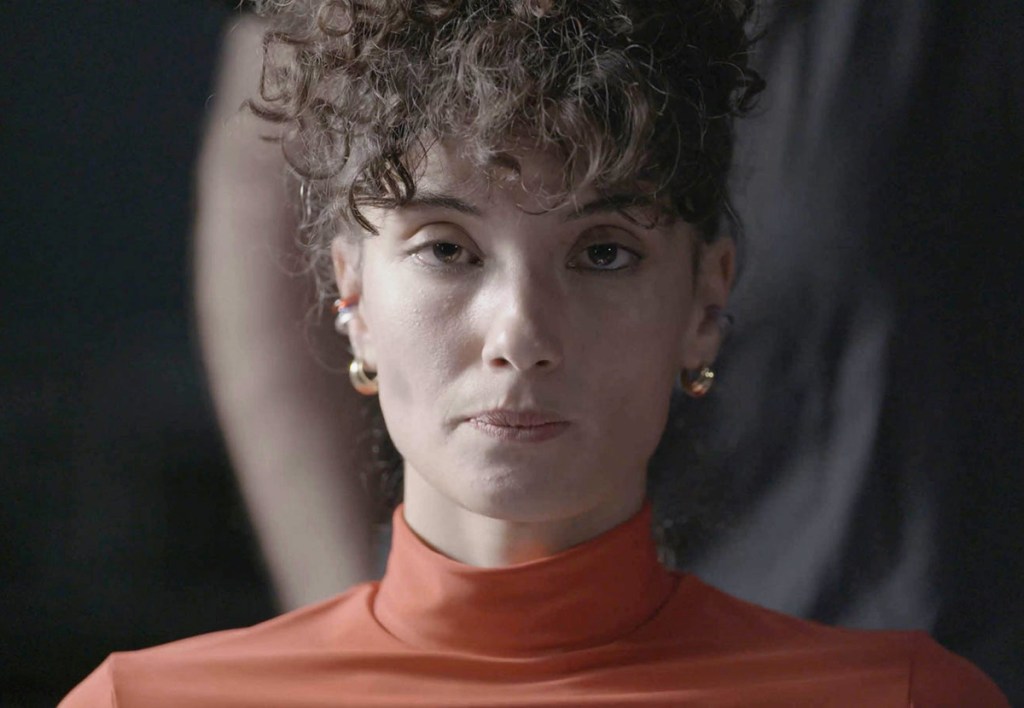
An experimental thriller shot in Iran, 1001 Frames feels universal as it explores the abuse of power that could have happened anywhere in the world. A good pick from the Melbourne International Film Festival line-up.
I’ve always had a soft spot for movies operating within self-imposed restrictions, whether it be a single location or an extreme stylistic choice. The setting picked by the Iranian-American director Mehrnoush Alia for her feature could not be more minimalist: a dark sound stage with a single chair. The many women who come to occupy the chair are all aspiring actresses, auditioning for a part in a new adaptation of One Thousand And One Nights. The unseen male director of the film stays hidden behind his camera, which is focused on the women throughout.
This restricted camera perspective runs the risk of becoming repetitive over an hour and a half, but it’s more than compensated by the variety of women and their personalities. One of them is the director’s ex-wife, whose attitude is sceptical and scornful, and who openly accuses him of stealing her idea for the movie. Another is a minor with neglectful parents, who ran away from home just to take a part in the audition. Some women are confident, worldly and bold as brass, while others are more timid and eager to please. Strong performances from the cast do a lot to get you emotionally invested, and lift the film above a mere exercise.
The film’s simple approach gives it a strong documentary feel and a sense of immediacy, as if you are watching a real footage. With nothing else on the screen to distract you, the close-ups of women and their increasingly uncomfortable interactions with the man in charge acquire even more intensity. As the auditions progress, there’s a growing feeling that the director might have something more sinister on his mind than finding his ideal Scheherazade. His questions and requests become increasingly more explicit and intimidating, and the claustrophobic setting feels more and more like a trap.
The reactions of women vary from submission to outrage, and from disbelief to terror. Once again, this diversity of responses helps save a scenario that could have become a tad too one-note. As a viewer, I often found myself sharing in the women’s uncertainty. Is this guy a predatory creep, or is it all an elaborate act, designed to provoke extreme reactions for the sake of art? There are after all enough stories of eccentric auteurs and their often cruel methods to make you wonder.
The fourth wall-breaking ending of the movie wasn’t a hit with everyone in my group. Depending on your perspective, it’s either an infuriating cop-out, or a way to acknowledge the artifice of the whole thing, and perhaps hand some of the power back to women. Because the action takes place in the world of filmmaking, and therefore the world of performance and make-believe, the resolution worked well enough for me, and didn’t detract from the discomfort of everything that happened prior.
 yggdrasille.com