

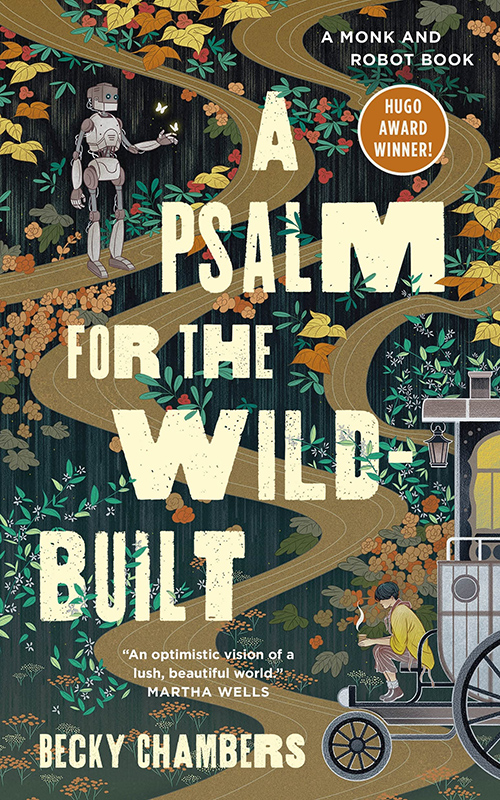
I didn’t hate this cozy sci-fi novella, but to me it felt like eating sugar-free cotton candy: I got absolutely nothing from the experience, not even a sugar hit.
I don’t mind a sweet and wholesome story once in a while, and I’ve nothing against the more utopian branch of science fiction, offering an optimistic and hopeful vision of the future. Becky Chambers’ book begins with a dedication to anyone who could use a break, and has been described as a true balm for the soul, a warm hug, a comforting cup of tea. It clearly resonates with many readers, but I simply wasn’t one of them.
The story takes place on a world called Panga where, several hundred years ago, robots gained sentience, put down their tools and retreated from the human society, never to be seen again. Since then, the humanity moved towards a more sustainable lifestyle, leaving half of the planet an untamed wilderness. Everyone resides either in Panga’s only city, a thriving and beautiful metropolis, or farms and small communities. Everything is peaceful and harmonious and lovely, with not a single wrinkle of a conflict in sight.
This idyllic existence is somehow not enough for Sibling Dex, a non-binary twenty-nine-year-old monk who comes to feel restless and dissatisfied with life. Dex leaves the city-bound monastery and becomes a travelling tea monk, listening to people’s troubles over cups of tea. After a rocky start, Dex is adored all over Panga, but being good at your job doesn’t always fix the crisis of purpose. And so one day Dex takes their wagon further into the uncharted wilderness, yearning for the sound of crickets and searching for some deeper meaning to it all.
The book is quite short and easy to read, and I finished it, but I realised very early on that it probably wasn’t for me. The writing is as gentle as a bubbling brook, an occasional expletive notwithstanding, and the story is so low-stakes it’s virtually non-existent. Some may find it restful and heartwarming, I found it too cutesy and beige. It did make me reflect on what I look for in science fiction, and why in the past I did enjoy some works that were also not plot-heavy. Sometimes it’s the beautiful or stylish way with words that captivates you, a great sense of humour, or a compelling protagonist with a unique perspective. Other times, you might get hooked on world-building and exploration of the Big Ideas.
Sadly I got none of these things from this novella. The prose is fine, but not exceptional enough to carry the book. The world-building is flimsy at best; Dex is remarkable for being the first non-binary main character I read about, and nothing else. I didn’t care about their existential angst or whether it would be resolved.
The book gets marginally more interesting when Dex encounters a robot called Mosscap, who is curious about the humanity and adopts Dex as a guide of sorts. This clash of species and cultures could have led to some interesting philosophical discussions, but the conversations between Dex and Mosscap are as twee and comfortable as the rest of the story, and hardly profound. I will say that at the very least the book didn’t feel pretentious or sanctimonious. I just didn’t care to be wrapped up in this particular blanket.
I can’t remember the last time I had such a nothing reaction to a book. I wouldn’t swear off the entire solarpunk subgenre because of it, but Becky Chambers is clearly not my cuppa in the slightest.

