

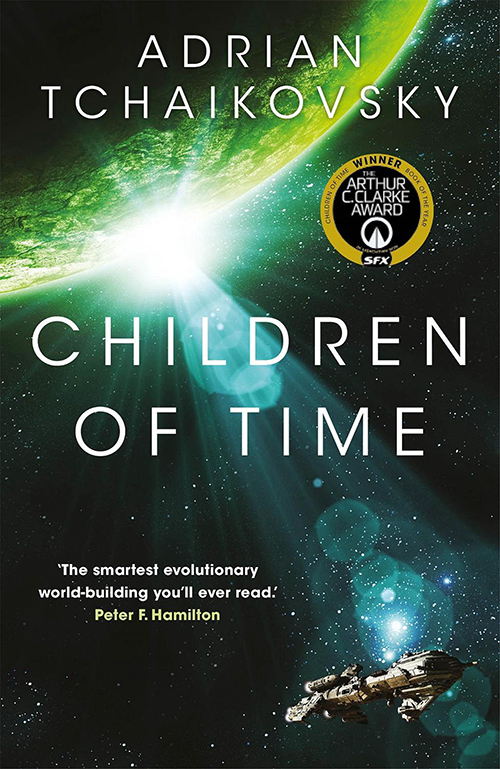
A sci-fi novel of staggering ambition and scope, Children of Time captivates with its incredible world-building and epic grandeur, if not with prose and characters.
This book was praised to me many times by various people, and having finally read it I’m grateful for their recommendations. Even if I didn’t love absolutely everything about Children of Time, this is without a doubt a truly impressive work of modern science fiction that subverted my expectations multiple times.
The story begins with a disaster. In the distant future, humans are traversing star systems and terraforming distant planets for habitation. One such project is headed by Dr Avrana Kern, who is about to oversee her greatest achievement: a group of monkeys sent to a planet along with a virus that would accelerate their evolution into intelligent beings. Everything goes pear-shaped when a fanatical crew member sabotages the project, destroying the monkeys and the station, and leaving Dr Kern all alone, stranded on a life pod orbiting the planet.
From then on, the book alternates between two different narratives, both spanning thousands of years. On Kern’s World, the virus originally meant for monkeys selects an unexpected species: spiders, in particular the tiny but fierce jumping spider known as Portia labiata. Over centuries, the spiders grow in intelligence and their society evolves and advances beyond anyone’s imagination.
Though I don’t have a full-on arachnophobia, I can’t say that spiders are my favourite creatures, and on a few occasions I found a huntsman in my home the sight always filled me with pure animal revulsion. However, the chapters chronicling the rise and tribulations of the spider civilisation were by far my favourite, filled with some of the finest, most imaginative world-building I’ve ever experienced. I often found myself cheering on the spiders, particularly in the chapters dealing with the terrifying existential threat of ant invasion. Tchaikovsky has an academic background in zoology and psychology, and it definitely comes through in his attempt to write a believable history of a complex, utterly alien society with biology-based technology and its own unique social structures. And yet, many developments here clearly echo the familiar aspects of the human civilisation, such as the rise of religion and struggle for gender equality.
Parallel to the rise of spiders, we follow the remnants of the human race aboard the space ark The Gilgamesh. Since the failure of Dr Kern’s project, some two thousand years have passed. The Old Empire is long gone, and the last human survivors use the recovered technology in order to escape the dead and uninhabitable Earth. Desperately searching for a new home, they arrive at Kern’s World, only to be greeted by the nearly-insane and very cranky Dr Avrana Kern, now merged with the life pod’s computer. She feels little kinship with these remainders of humanity, and is adamant to keep them off her world, which she believes is inhabited by her precious intelligent monkeys.
Dr Kern is the only truly memorable character in a book that doesn’t shine in this regard. To be fair, Tchaikovsky uses a nifty device in order to create continuity between the many generations of spiders, by always using the same three names that become a useful shorthand for social roles and temperaments. In every generation, there’s Portia, typically a leader, brave and curious. Then there’s Bianca, a scientist and free-thinker, and Fabian who represents the underclass of male spiders. This way, you quickly grasp the essence of characters without the book having to introduce and explain them over and over.
Aside from Dr Kern, the human characters are serviceable rather than compelling, but Tchaikovsky does throw in an interesting twist through the device of suspension. Onboard the spaceship, the key crew members can enter what is effectively cold storage, and sleep through centuries until their active presence is required again, often waking to find themselves in shocking or dangerous situations. How does an average human brain cope with the weight of thousand years? The book doesn’t delve into it anywhere as deeply as I’d like, but this idea of a human lifetime extended to god-like span is fascinating.
The story sets the two species on an inevitable collision course, and I half-assumed that a significant chunk of the novel would be dedicated to the battle for Kern’s World, if not most of it. To my surprise, the eventual confrontation happens much, much later than I anticipated, and is resolved in a way I never saw coming yet found completely satisfying. It is to Tchaikovsky’s credit that I was positively dreading the outcome, and felt invested in the fates of both spiders and humans, even if my realistic reaction to meeting a giant spider would be to scream my head off.
 yggdrasille.com