

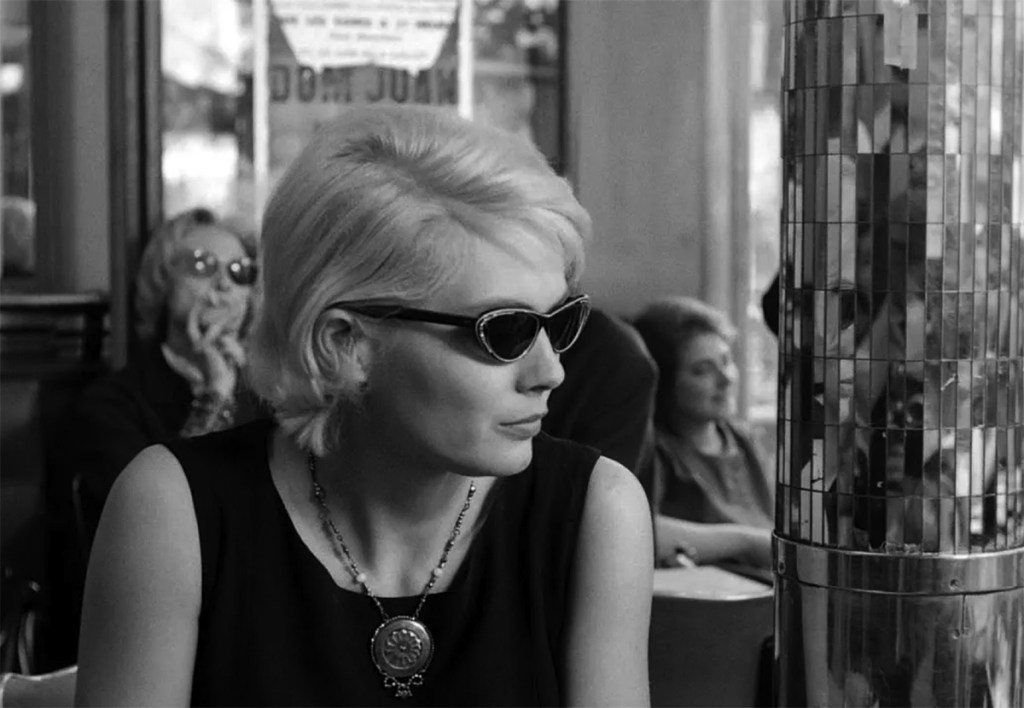
I dipped my toes into the French New Wave cinema with this delightful classic from filmmaker Agnès Varda, an effortlessly elegant snapshot of 1960s Paris that I couldn’t wait to rewatch.
Unfolding in real time, the movie spends a summer afternoon with Cléo (Corinne Marchand), a young and beautiful pop singer of minor fame. As the movie opens, Cléo has an anxiety-ridden session with a fortune teller, who sees a grave illness in the tarot cards, shot from above with the geometrical precision you would now associate with Wes Anderson movies (it is also the only colour sequence in the black-and-white film). The visit makes Cléo even more nervous about the official results of a biopsy she’s about to learn in a couple of hours.
If you were to describe the events of these two hours, they wouldn’t amount to much on paper. Cléo buys a très chic black fur-trimmed hat, incongruous with the weather outside but maybe indicative of her mood. We see her glamorous and strangely empty Parisian apartment, which has a piano, a swing and kittens frolicking all over the place. Cléo’s older lover pays her a visit that seems to be about ritual rather than feelings; later she rehearses new songs with a couple of musicians who, along with Cléo’s rather superstisious maid, seem to regard Cléo as a spoiled capricious child. Cléo wanders the streets, visits a friend, a life drawing model, and has a charming encounter in the park.
All of this sounds trivial, but Agnès Varda’s film is all about execution rather than plot, and is enriched with a thousand little details that make a rewatch so rewarding. It’s closely attuned to the thrum of the big city and the never-ending dance of cars, trams and pedestrians, constantly overhearing snippets of random conversations, catching the glances of men who all turn their heads as Cléo passes by. It picks on seemingly unimportant details like the brief shot of a wall Cléo sees as she’s walking down the stairs. It all amounts to a feeling that a sharper sense of her own mortality somehow changes Cléo’s perception of the world and people around her. It makes her feel apart, but also transforms her.
There’s wonderful playfulness about Varda’s varied shot compositions and camera techniques, though I did have to avert my eyes from one scene in Cléo’s apartment where the camera swings from one face to another along with the music (this is thankfully the only dizziness-inducing moment in the film). Otherwise, these techniques blend into a harmonious whole that doesn’t feel over-directed, and never calls attention to itself in a show-off, “look at me” fashion.
Cléo’s personal journey is likewise subtle, as she wrestles not just with the notion of impending doom, but also the broader dissatisfaction with her life. She is vain and childish; “as long as I’m beautiful, I’m alive,” she muses to herself early on as she looks in a mirror. However one gets the sense that her shimmering blonde beauty makes her feel obligated to perform and be what everyone expects her to be. When Cléo takes off on her own in the second half of the film, she also starts shedding layers of her old self (though she still takes time to pick an elegant necklace to go with her simple black dress).
P.S. Cléo from 5 to 7 runs for breezy ninety minutes, but I felt like I could have spent three more hours with Cléo hanging around Paris, even if this 1960s Paris is not an airbrushed postcard. Along with the scenery that made me swoon at my own memories of the City of Lights, there are also student riots and bullet-smashed windows, and war in Algeria looming large.
 yggdrasille.com