

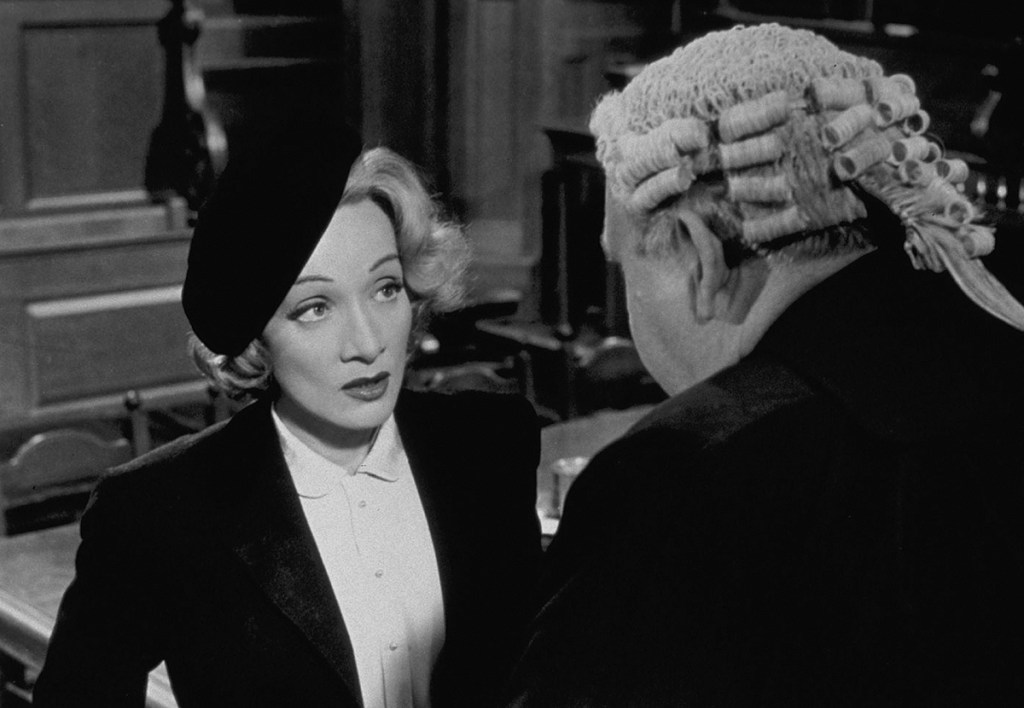
This excellent courtroom drama, based on Agatha Christie’s short story and later play, is widely considered to be one of the very best Christie film adaptations. It’s also my first time seeing the magnetic Marlene Dietrich onscreen.
Since I already read the short story not so long ago, I didn’t expect any further revelations. Little did I know that Christie, dissatisfied with the original ending, rewrote it for her stage play, keeping the same major twist but adding something extra that fundamentally changes the story, in a way that was probably more in tune with the morals of the time. I would have enjoyed the movie anyway, but it was an even better first watch for springing a surprise on me after all.
Sir Wilfrid Robarts (Charles Laughton) is a famous British barrister nearing retirement, having recently suffered a serious heart attack. He’s supposed to be recuperating under the watchful eye of his nurse, Miss Plimsoll (Elsa Lanchester), and stay well away from all criminal cases, but he can’t help but be drawn in by the story of a would-be client named Leonard Vole (Tyrone Power). Vole comes to Sir Wilfrid because he fears arrest for the murder of Emily French, a wealthy, lonely widow he befriended, a justified fear since the police show up mere minutes later.
Vole seems a likeable fellow and he protests his innocence, but his case looks grimmer by the minute, especially when it’s discovered that the besotted Miss French made Leonard the principal heir to her fortune. Worst of all, he has no solid alibi whatsoever other than the word of his German wife Christine (Marlene Dietrich). When Sir Wilfrid meets Christine, she does not look at all upset, in fact she’s cool as a cucumber and as inscrutable as a sphinx. Strange behaviour from a supposed devoted wife, but it still doesn’t prepare Sir Wilfrid for Christine’s shock appearance as a witness for the prosecution during the trial.
Marlene Dietrich is utterly alluring as enigmatic Christine, a woman whose motives and passions stay hidden behind her remote, icy exterior. The movie however belongs to Charles Laughton and his commanding, enormously entertaining performance as a larger-than-life character. At first there’s something comical about Sir Wilfrid’s general appearance and his petulant bickering with his nurse, but as a barrister he’s shrewd and razor-sharp. His fragile health and reliance on all sorts of pills gives him a layer of vulnerability and adds even more tension to the already riveting courtroom scenes. Whether he’s smacking down the prosecuting attorney, being terribly rude to long-suffering Miss Plimsoll, or showing childlike delight at the newly installed lift in his office, Sir Wilfrid is just so much fun to watch.
In the wrong hands, the material could have come off as overly talky or stagey, but Billy Wilder’s assured direction and witty dialogue keep the story ticking along towards its thrilling conclusion. A couple of added flashbacks do a lot to flesh out the characters, including the first meeting between Leonard and Christine back in war-torn Germany (where Dietrich’s legendary legs make a flash appearance).
Witness for the Prosecution has a couple of dated moments, especially during some heated scenes in court where acting comes very close to overacting. It also runs into a problem where a particular story device works fine on page or onstage for that matter, but requires extra suspension of disbelief onscreen. Regardless, this is a top-notch adaptation of top-shelf Christie, and it’s hard to see how any further iterations could surpass it. Though I still want to check out the 2016 TV series with Kim Cattrall as sexy Miss French and Andrea Riseborough as Romaine (Christine’s original name in the short story).
 yggdrasille.com