

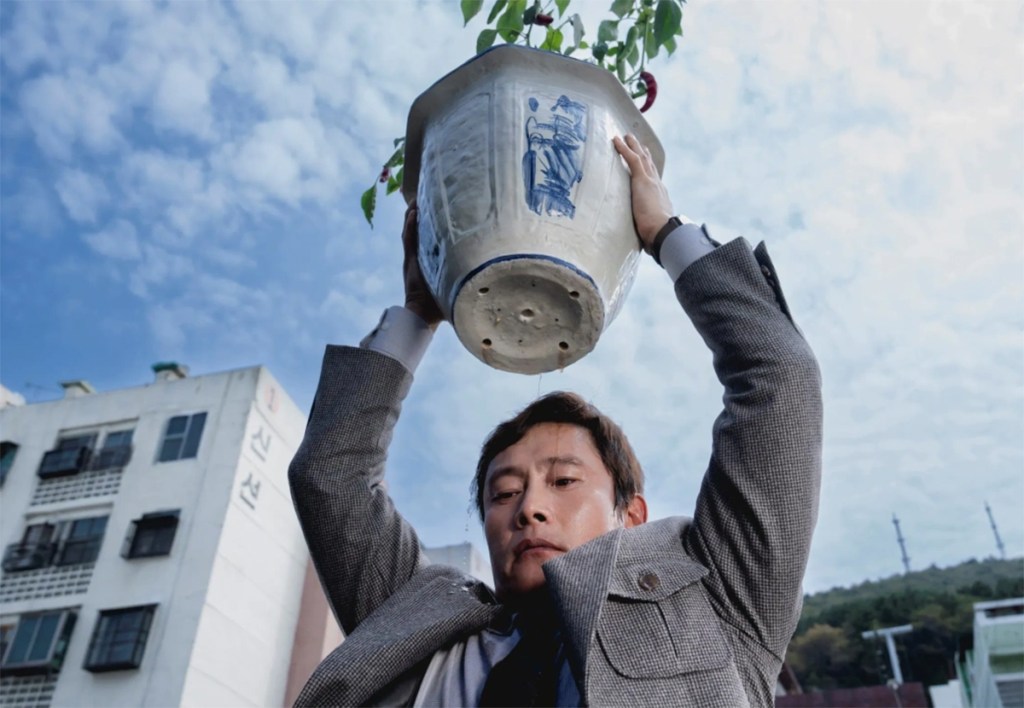
I skipped the beach and went to the Classic Cinemas for a South Korean double from auteur director Park Chan-wook.
Before this year, I haven’t watched a single Park Chan-wook film, and now I’ve seen three in a space of a week. I started with Decision to Leave, a multi-layered blend of crime thriller and romance considered to be one of his lesser films; lesser or not, it still impressed me with its razor-sharp, visually striking filmmaking and twisty storytelling. Later that week, I thought I’d combine a pick from the Park Chan-wook retrospective at the Classic with his newest release. It wouldn’t usually be my choice to spend a fine summer afternoon and evening in the darkness of the cinema, but I really had a blast with both films.
No Other Choice is an increasingly vicious pitch-black comedy where humour goes from playful and silly to dark and uncomfortable, while always remaining entertaining. As it begins, our hero Yoo Man-su (Lee Byung-hun in a perfectly calibrated performance) seems to have everything: lovely house, lovely wife, two children and two adorable Labradors. As a cherry on top, he’s just been gifted some eels by the new American owners of the paper company where he’s employed, which he grills in the opening scene.
This gift however is an omen of bad things to come, because Man-su’s new bosses soon conduct a cull, with Man-su one of the redundancies. Belts have to be tightened, including cancelling Netflix and handing over pets to the relatives, and after three fruitless months in a brutal job market Man-su comes up with a plan that puts a whole new spin on climbing the corporate ladder. He will place a phoney recruitment ad for a fake paper company in order to suss out his competition, and then he will eliminate those with better qualifications. “Slay them all!” says Man-su’s unsuspecting wife as she farewells him in the morning, not realising that her husband means to do so quite literally.
For a film with a simple premise, No Other Choice feels chaotic and wildly unpredictable, simply because of its many bizarre and absurd set pieces that veer from tension to slapstick to pathos in the same scene; a good example is a home invasion involving Man-su, one of his rivals, his over-the-top wife, a fight for a gun and shouting over comically loud music. The film also weaves in subplots dealing with Man-su’s family troubles and his fraying self-image as a man and breadwinner. These tangents at times made the movie feel longer, but I wouldn’t want them taken out either.
It takes astonishing skill and confidence to make a film so tonally complex, and I felt at all times that I was in the hands of a true cinema master. The movie also feels bleakly topical in this era of workforce shrinkage and the threat of new technology. I’ve already mentioned Lee Byung-hun’s performance, but I can’t understate just how impressive he is at walking the tightrope and balancing out Man-su’s many aspects: relatable, bumbling, intelligent, insecure and chilling.
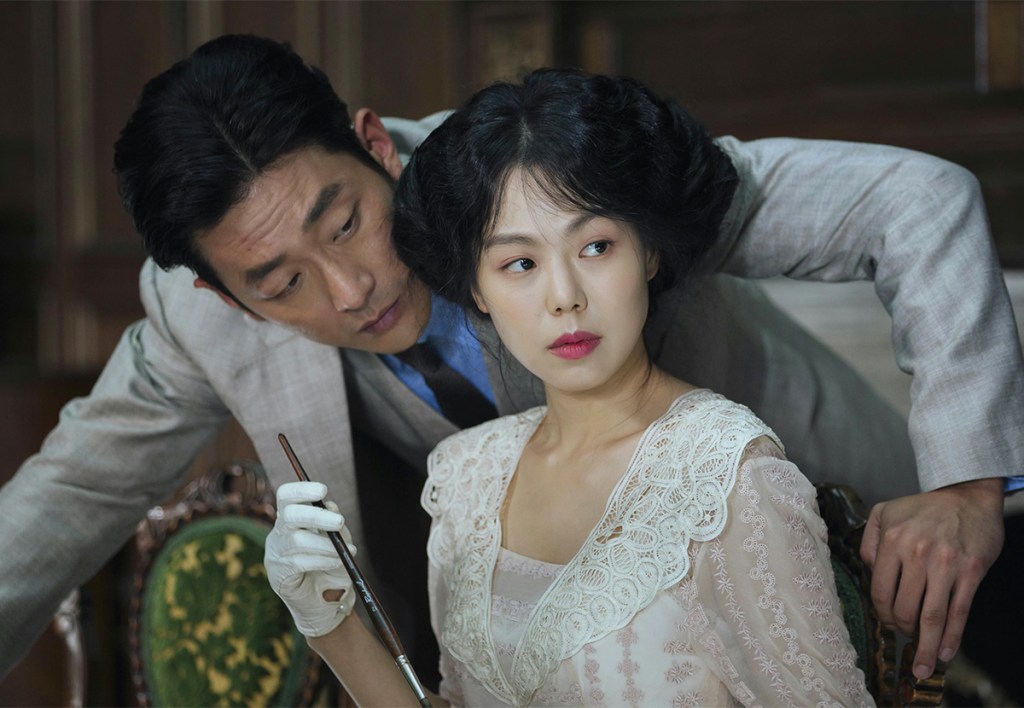
A luscious, erotic historical thriller, The Handmaiden was just as much of a wild ride, though in a very different way. It abandons modernity for the Japanese-occupied Korea of the 1930s, where a young poor pickpocket named Sook-hee (Kim Tae-ri) is pulled into a scheme. She is hired by a pretend Count (Ha Jung-Woo) as a handmaiden at the house of a rich book collector, to serve the niece of his deceased wife, Lady Hideko (Kim Min-hee). She is to gain the trust and confidence of Hideko in order to convince her to elope with the handsome Count, who can then proclaim her insane and dump her in a lunatic asylum so that he and Sook-hee can enjoy the spoils.
When she arrives at the opulent mansion, Sook-hee is instantly struck by Hideko’s sad, exquisite beauty, heartbreaking vulnerability and sheer tragedy of her situation, raised in luxurious confinement by an obviously sinister, abusive old man. In short, she catches feelings that complicate the situation, and what more, they seem to be reciprocated.
It’s impossible to talk about the story any further without spoilage. Suffice to say, nothing is as it seems in this densely plotted tale of seduction, revenge, double and triple crosses and dizzying point-of-view shifts that make you reconsider everything you’ve just seen. One of the many pleasures of The Handmaiden is the casually scattered clues and small tidbits of information, which are then revisited in later scenes to give the viewer a full picture and complete the puzzle.
The film also gets more perverse and sexual, with some of the strangest pornographic scenes (with all participants remaining clothed) I’ve seen on screen. They are contrasted with the tenderly erotic scenes between Sook-hee and Hideko, where all surfaces and textures feel positively charged. I will say that my inner feminist did feel a tad conflicted about the more frank and explicit sex scenes much later in the film. They may intend to portray an escape from the male exploitation, but I couldn’t help but feel that they in turn are equally meant to titillate the male gaze. These few jarring notes aside, The Handmaiden is audacious, sumptuous, beautifully shot and acted.
P.S. Based on the brief moments of violence at the end of The Handmaiden, I don’t know if I have the stomach to watch Park Chan-wook’s Oldboy, described as not for the squeamish.
 yggdrasille.com