

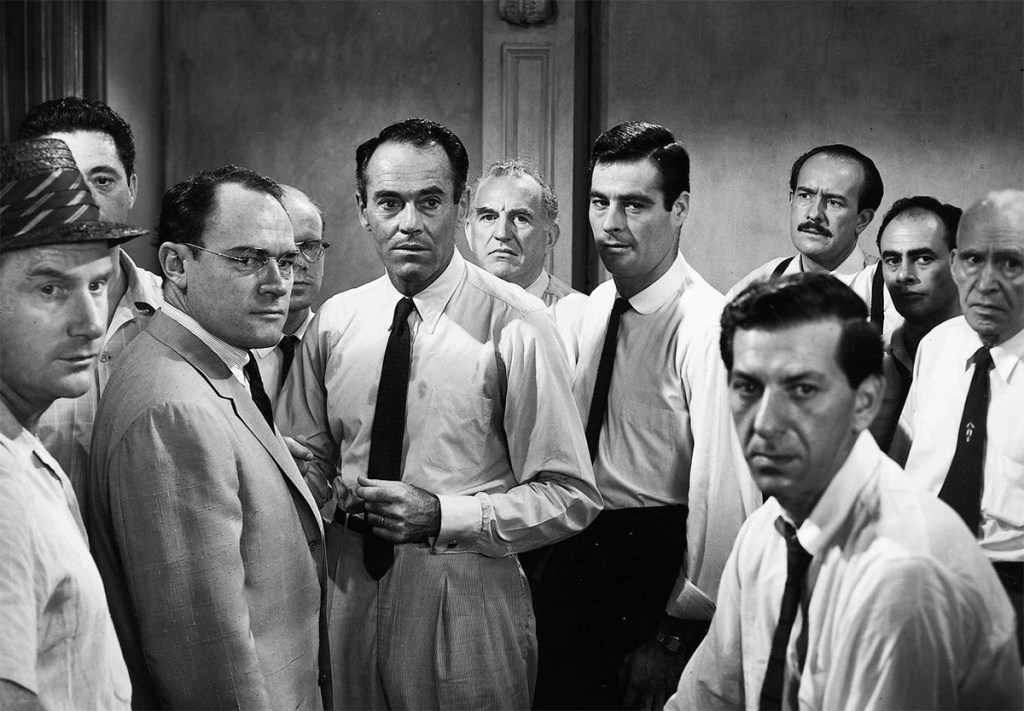
This blistering courtroom drama from director Sidney Lumet held me in such thrall from start to finish I didn’t dare pause it once.
I was already familiar with the basic premise of the movie after watching 12, the 2007 Russian remake of Lumet’s classic that in turn is based on the 1954 teleplay. I did enjoy Nikita Mikhalkov’s version at the time, however in retrospect it feels rather overwrought and melodramatic next to Lumet’s lean, mean critique of the American jury system. Shock and surprise, the original is better.
Other than a minimal setup and a brief epilogue, the film takes place entirely within a jury room on a hot summer day in New York City, where twelve men must decide the fate of an 18-year-old boy accused of murdering his abusive father. His exact ethnicity is never specified, but he looks different from the all-white jury, and comes from impoverished background. Before the men retreat into the room, the judge instructs them that they must deliver an unanimous verdict, and that in case of reasonable doubt they must proclaim the defendant not guilty. The guilty verdict carries a mandatory death sentence, an electric chair.
As the jury gathers in the small, stifling room, the mood is perversely light and almost everyone expects to be going home very soon, as the verdict seems a foregone conclusion in what looks like an open and shut case. When the first ballot is taken, everyone votes guilty… until it gets to Juror No. 8 (Peter Fonda), who argues that they should discuss the case more before the verdict. He’s careful to point out that the young man might well be a murderer, and in the end the film itself never states if he is guilty or not. It’s all about the reasonable doubt, and Juror No. 8 strongly believes it’s present in this instance.
Some of my favourite movies are about the group tensions and personality clashes within a confined space, and 12 Angry Men is an absolutely riveting example of this scenario. The twelve jurors all represent different facets of the society with their different backgrounds and occupations, and their personalities gradually surface as they go over the details of the case and debate the evidence. Some of them are open to persuasion, some passively go with the flow of the majority, while others are so wedded to their personal biases and prejudices they simply refuse to listen. Not everyone who sticks to the guilty verdict late in the game is portrayed as stubborn or bigoted; one juror does so purely from a position of logic unswayed by emotion.
The movie raises important questions about the power of conformity, the role of an individual in collective decision-making and the fallibility of the legal system. I have to says, I did find it a teensy bit implausible that absolutely no one involved in the case thought to bring up the many points and flaws in the evidence uncovered during the jury discussion, even accepting that the case was handled sloppily and without due care.
12 Angry Men is basically a talky play, but the camera is a dynamic presence throughout and there are some incredibly effective close-up shots during important moments. It’s not an easy task to make a compelling story in a single nondescript room, but Lumet’s cinematic craft, intelligent script and strong ensemble performances kept me engaged and loathe to interrupt the movie even for a second. That cup of tea I craved had to wait until the credits.
 yggdrasille.com