
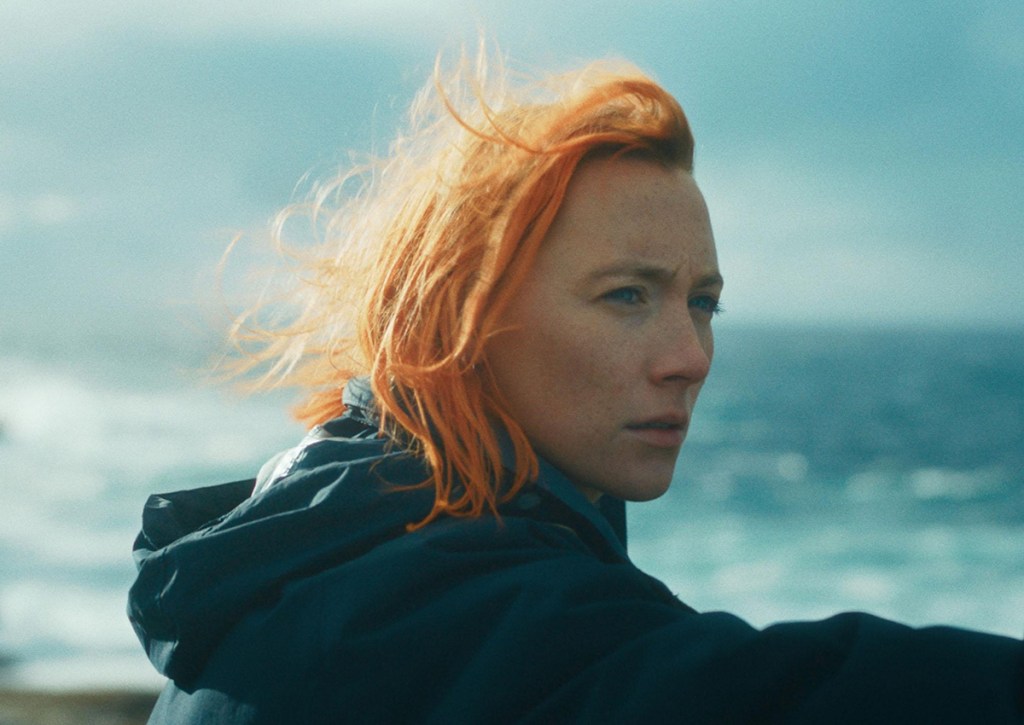
Saoirse Ronan is mesmerising in this stark, tough story of addiction and recovery set against the windswept landscapes of the Orkney Islands.
I’m a huge fan of Saoirse Ronan, but what really sold me on this movie was the setting. My never-was big European trip of 2020 included a visit to Orkney, the North Sea archipelago off the coast of Scotland. I still hope to some day visit its sandstone cliffs, the island of Skara Brae, the ancient Neolithic ruins, but in the meantime there’s this excellent and ultimately rewarding movie, based on a memoir by the Scottish author Amy Liptrot.
Ronan is Rona, a biology postgrad student in London, who returns to Orkney after spending time in rehab. Her descent into alcoholism is told out of order in short, impressionistic flashbacks, in which Rona’s bright shades of hair serve as helpful time markers. In them, she’s fun-loving one moment, and then aggressively drunk in ugly, out-of-control episodes. Her addiction costs Rona her relationship with a kind, caring boyfriend, and lands her in a terrifying, potentially life-threatening situation. There’s a jittery, disorienting feel to the film’s earlier scenes, no doubt meant to convey Rona’s own disoriented state of mind.
Back home, Rona has an uneasy relationship with both of her divorced parents, a devoutly Christian mother and a bipolar father living in a caravan, having been forced to sell the family farmhouse. She joins the local AA meetings, and takes on a volunteer job surveying the inhabited islands for an endangered species of birds. Just when you thought that Rona’s life was quiet and isolated enough, she takes it up another notch after a relapse scare, relocating to a tiny cottage on Papa Westray, one of the smallest islands in Orkney that feels like the end of the world.
The Outrun is a blend of addiction drama and a movie sub-genre I’ve always had a soft spot for, stories of people who find healing and redemption in nature. Rona’s own journey here is internal rather than a literal adventure out in the wilderness, but the transcendent power of the natural world is still a major theme. Even if the severe landscapes of Orkney don’t invite easy sentimentality with its jagged cliffs, treeless expanses and ferocious winds.
There’s also a touch of documentary in Rona’s many side notes that give the movie a distinctive texture and add to the already strong, atmospheric sense of place. These cover everything from the local folklore, including an animated legend about a sea monster that gave birth to Orkney, maritime history, flight paths of birds, planes and space stations. The interludes at times risk disrupting the flow, but they do feel natural as coming from Rona’s restless, scholarly mind. The islands’ seals, recast in Rona’s voiceover as magical shapeshifters, are especially memorable, beautiful and majestic underwater, both cute and creepy when sticking their heads out and silently observing the humans.
Saoirse Ronan’s focused, emotionally charged performance holds together the movie that could have been too much of an episodic patchwork. Wisely, the film contains many closeups of her captivating face. One of the best actors of her generation, she seems incapable of ever looking blank; she’s also always excelled at playing flawed, abrasive yet sympathetic characters. There are many standout, powerful moments, such as when Rona confesses that she is incapable of being happy when sober, or when she’s trying her hardest to ignore the siren song of the bottles behind the friendly shopkeeper while buying groceries.
Rona’s story ends on an optimistic note, but without any illusions about the difficulties of her newly won sobriety. I also liked the way her recovery unfolded as a collection of small daily experiences; by the time the movie rolled out its big theatrical crescendo, I was far too invested to object. Addiction stories are dime a dozen, with the same beats repeated over and over, but this raw and lyrical film really felt like a beast of its own.
 yggdrasille.com