

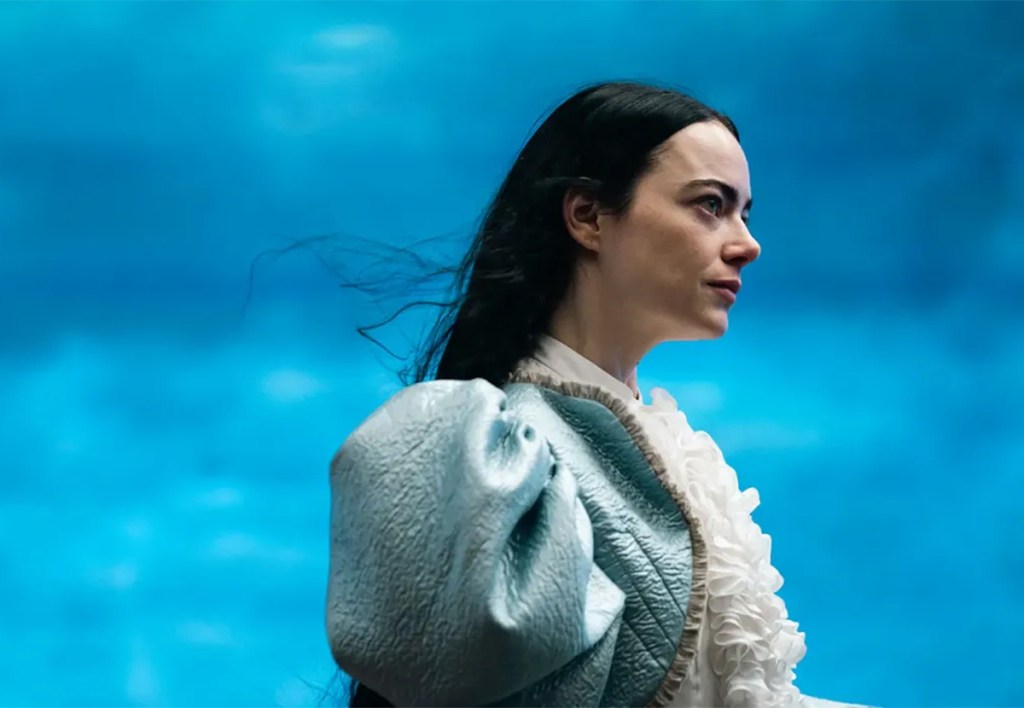
I absolutely loved this deliciously bizarre, macabre and raunchy comedy, with Emma Stone in her best performance to date.
I respected Yorgos Lanthimos’ The Lobster and I really enjoyed The Favourite, but Poor Things is the first movie of his I unabashedly fell in love with. This absurdist fantasy conjures up a wildly inventive and strange world (think Victorian steampunk on acid with dashes of Gaudi), and I’ve come to enjoy Lanthimos’ unique tone and perverse sense of humour. However what ultimately made the movie so enchanting to me was Stone’s unforgettable Bella Baxter and her journey of self-discovery in the big bad world.
In the opening scene, we see a young woman throw herself from London’s Tower Bridge in an attempt to take her own life, but her story doesn’t end there. In a twisted take on Mary Shelley’s Frankenstein, she is reanimated by deformed Dr Godwin Baxter (Willem Dafoe in a charismatic and sympathetic turn). Bella, as this new creation is known, is childlike and barely verbal, with violent impulses that at times find a shocking outlet. She is looked after by Dr Baxter, who develops a great deal of paternal affection for Bella, his stern-faced housekeeper, and a research assistant Max McCandles (Ramy Youssef), whose feelings for Bella acquire more of a romantic nature.
Troubles begin when Bella discovers a dual passion for the outside world and masturbation. Hoping to contain his charge, Dr Baxter tries to arrange a marriage between Bella and Max, on a condition that the couple continue living in his fabulously lavish mansion of body horrors (including a chicken with a pig’s head roaming around).
If only he hired a different solicitor to formalise the union: Duncan Wedderburn (Mark Ruffalo, mustachioed and gloriously hammy) is a sleazy libertine and seducer who instantly throws himself at Bella. She in turn grasps the opportunity to escape and explore her newly found autonomy. Her creator finally resigns himself to the loss, and so Bella embarks on a decadent European adventure that involves Portuguese custard tarts, philosophy books, and lots and lots of sex.
The movie is split into chapters, and once Bella leaves home the film shifts from black-and-white into hyperreal, richly saturated colours. The production design and costumes in Poor Things are out of this world, quite literally as the movie gleefully re-imagines real-life locations like Lisbon into highly stylised, artificial sets. It likewise warps 19th-century fashions, mixing giant puffy sleeves with yellow silk shorts and sunglasses. Together with Lanthimos’ trademark fisheye shots and unsettling, dissonant score, it makes the movie feel quite unlike anything else I’ve seen before.
Bella is an utterly fascinating and beguiling centre of this carnival of oddness, brought to life by Emma Stone in a bold, unhinged, physically committed performance with the same gusto Bella grabs at life and everything it has to offer in the movie. Bella still has trouble controlling her body and limbs, resulting in an awkward gait and strange, jerky head movements. Her speech has the same stilted yet endearing quality, becoming more complex and florid as her vocabulary expands. Bella’s saucer-sized eyes take in the world with hunger and intensity of a small child, but she also often processes things in a cool and amused fashion, as if an alien visitor conducting an experiment. She bluntly rejects societal constraints, as well as any attempts to entrap and tame her.
Bella’s personal journey stalls somewhat in the last third of the movie set in a Parisian brothel, though it still remains a grotesquely entertaining and often hilarious exploration of kinks. There’s also an unexpected fourth act that feels a bit rushed and heavy-handed; I wouldn’t call Poor Things a subtle movie in any sense, but it is particularly unsubtle in its last stretch where its themes are concerned.
I also felt that Bella’s story is missing something without a human experience of falling in love and having her fierce commitment to independence truly challenged. It made me think back to My Brilliant Career, another film about an untamed young woman that successfully mixed feminism and romance in a way modern movies with a feminist bent seem to shun. In the end, Poor Things does turn into a love story of sorts, and together with its truly singular heroine and visual magnificence it’s one of the main reasons I took to this odd duck of a movie so much.
 yggdrasille.com
Excellent review. Glad to hear that you loved it. I’m definitely keen to watch it soon. Yorgos Lanthimos is one of those directors with peculiar style. That being said, I adore Emma Stone who has been an amazing actress throughout a career. I loved her turn in “La La Land”. Here’s why I adored that movie:
LikeLiked by 1 person
I’ve been a massive fan of Emma Stone since her turn in Superbad. She was good in La La Land but I do think that working with Lanthimos seems to have unlocked a whole new acting level in her that I didn’t see coming. It’s so great to see her take risks.
LikeLiked by 1 person