

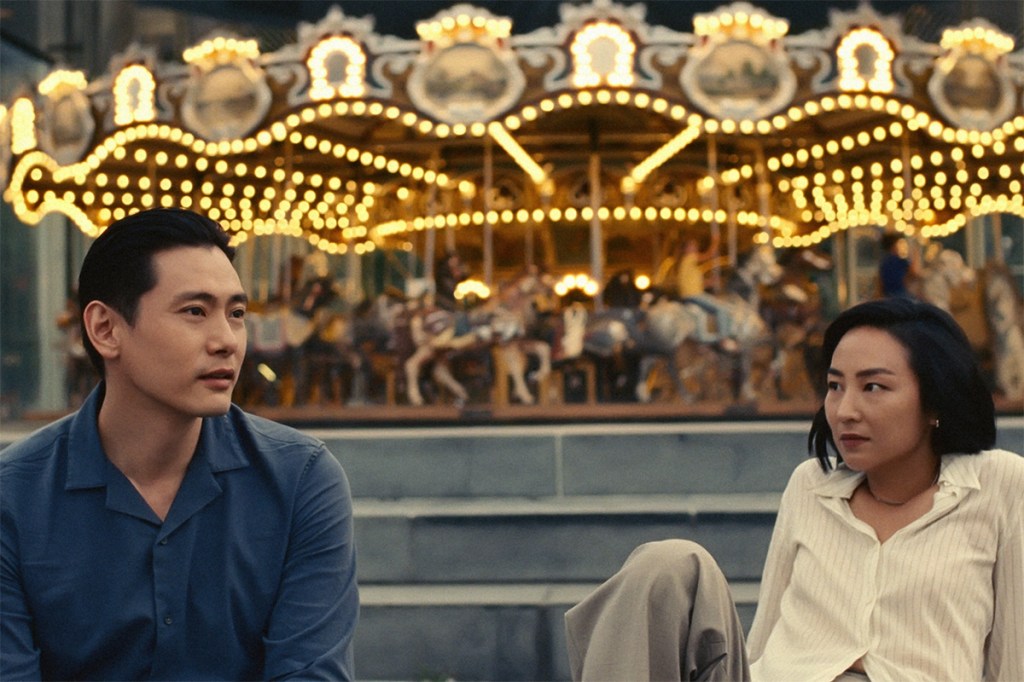
Gorgeous, mature and delicately bittersweet romantic drama about childhood sweethearts reconnecting over the years.
I’ve been hearing great things about this rapturously received debut feature from Celine Song for months now, and it was wonderful to watch a movie that actually lives up to the praise. This exquisitely written “what if” story of roads not taken is achingly sad in the best possible ways.
In an arresting opening scene, we see three people in a bar, a woman seated between two men, while some unseen voices are playing a popular onlooker game, trying to guess what the trio’s relationships with each other might be. Try as they might, their chances of accurately guessing the story that follows are practically nil. The movie then jumps 24 years backwards to Seoul, where Na Young and Hae Sung are growing up together as over-achieving besties. Their friendship tentatively turns into something more after a sweet, parent-chaperoned date, but these nascent feelings are cut short when Na Young and her bohemian parents move to Canada.
Twelve years later, Na Young, now more Anglo-friendly Nora (Greta Lee), is an aspiring playwright in New York City, while Hae Sung (Teo Yoo) is an engineering student back in Seoul. The pair reconnect via Facebook and spends hours on Skype chats, punishing time zone difference be damned. However neither of them is prepared to take a plunge and make a trip, and Nora especially is worried that the intensity of their relationship might jeopardise her professional ambitions. After she puts their friendship on an indefinite hiatus, it takes twelve more years before Nora and Hae Sung reconnect again. He finally visits New York, and brings out to the surface all the feelings long thought buried.
It feels like it’s been a long time since I’ve seen New York City onscreen in such a vibrant, romantic glow, as the long-delayed reunion takes the pair to Brooklyn’s waterfront and ferry rides. No matter where they go, it feels like a city for two, where nothing matters except for their palpable connection and raw chemistry that’s noticeably missing in Nora’s marriage to a sensitive, supportive, emotionally available fellow writer she met at the artistic retreat. This is however a film made with both feet firmly on the ground, where both people are aware of being on different paths in life and can only mourn the might-have-been. Their scenes are electric with all the restrained emotion just under the surface.
Along with a romance that never was, the film weaves in the examination of an immigrant experience I found relatable in many different ways, especially the dueling sensations of instant familiarity and yawning gulf when interacting with someone from the country of your origin. “I feel so not Korean when I’m with him, and also more Korean,” Nora says of Hae Sung, the only person who still calls her by her Korean name. Nora’s husband meanwhile laments that the difference in their background leaves a part of her inaccessible to him. The cultural displacement seems worth it in the end for Nora, but it still comes at a cost and traces of a vanished past remain.
Past Lives is a quiet slow burn of a movie, carried by its fine-tuned performances, with most of its power found in stretches of silence and things left unsaid. Also, I rarely notice the music in the movies these days, but the lovely score from the members of Grizzly Bear definitely stood out to me.
 yggdrasille.com