

I finally watched Barbie and found it a bit of a hot pink mess… but an entertaining, fun and refreshingly weird mess for sure.
I was actually content to wait for Barbie to hit streaming, before I got talked into watching the movie at the cinema after all (a free ticket was involved). In the meantime, as someone who likes to follow pop culture, I watched on with amusement as a movie about a plastic doll became the heavyweight champion of film discourse in 2023, inviting hot takes ranging from “feminist masterpiece” to “man-hating garbage” to “secretly conservative actually”. Having seen the film, these contradictory opinions made total sense. Barbie is basically a pink Rorschach test, full of competing ideas and tonal swings that make it possible to interpret the film however way you prefer.
My personal history with Barbie the doll is that I don’t have any personal history with Barbie. Dolls were never really my thing growing up, though at one point I had a Sindy (Barbie’s less famous British rival), who was a mannequin for doll clothes I either made from special patterns or designed myself. The Barbie movie had no nostalgic pull for me, but the involvement of writer-director Greta Gerwig did make me curious. I loved Gerwig’s coming-of-age gem Lady Bird, and though I didn’t quite adore her take on Little Women I at least admired the attempt to do something new and different.
Of course an idiosyncratic talent is not a guarantee in this age of factory filmmaking and corporate interests, especially where property like Barbie is involved, so it’s rather heartening to discover that Barbie is one of the strangest, wackiest billion-earning blockbusters in lord knows how many years. It is also irresistibly funny, embracing the kind of silly humour found in comedies like Zoolander, and throwing in hilarious nods to 2001: A Space Odyssey, The Matrix and Monty Python and the Holy Grail. And then there are ideas, oh so many different philosophical ideas and tones thrown in the mix by Gerwig and co-writer Noah Baumbach it’s all starting to feel overstuffed and confused long before the movie ends.
After a wry prologue about the origins of Barbie narrated by Helen Mirren, we’re brought into the candy-coloured, eye-popping world of Barbieland, where toy houses are transformed into a dazzling adult-sized playground. This is the home of Stereotypical Barbie (Margot Robbie), a rare Barbie not distinguished by any profession like President Barbie or Doctor Barbie, who are meant to inspire equal female achievements out in the “real world”. In this pink plastic realm, Barbies hold all the jobs and positions of power, while Kens are homeless accessories jostling for Barbies’ attention. Every day is a perfect day for our Barbie… until this perfect creature finds herself haunted by the thoughts of death, and develops messy hair, flat feet and -gasp- cellulite.
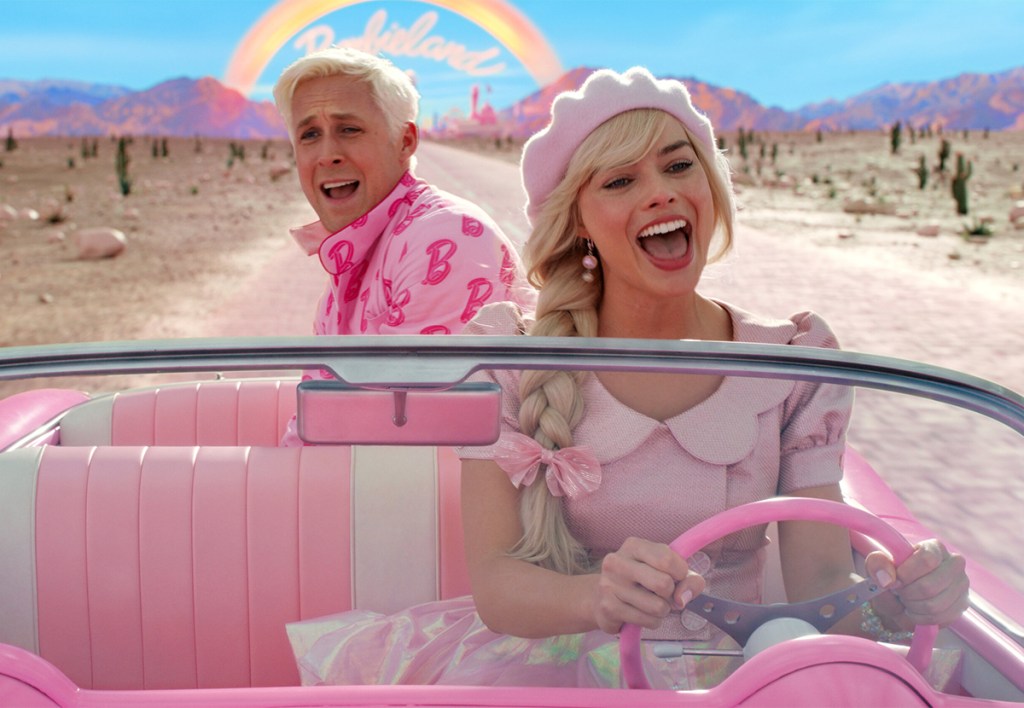
A visit to Weird Barbie (hilarious Kate McKinnon as a Barbie that got played with too hard by her owner) reveals that Barbie must travel into the real world, and somehow make things right for the girl who’s playing with her while having these dark thoughts. She reluctantly accepts the company of “her” Ken (Ryan Gosling), an insecure himbo who cannot imagine existence outside of being Barbie’s accessory (and hopefully boyfriend, though Barbie does not reciprocate Ken’s interest). Their whimsical journey involving a car, a rocket and a boat is yet another delightful visual feast.
The real world, or Los Angeles to be precise, is where the film’s ideas and plot strands begin to pile up on top of each other. Barbie is shocked and dismayed to discover that Barbies haven’t after all solved the problems of sexism and gender inequality. On the contrary, Sasha, the girl Barbie believes to be her owner (introduced as a genuinely unpleasant goth Mean Girl), nastily informs her that Barbie has been making women feel bad about themselves ever since she was invented.
This scene exemplifies one of the curious things about the movie as a whole. Are we meant to interpret Sasha’s diatribe as a legitimate criticism of Barbie and the doll’s negative influences, or as a comical take on an insufferable, sanctimonious modern teenager? Or maybe the movie, with Barbie creators Mattel breathing down its neck, wants to have it both ways, by first addressing the long-running criticisms of Barbie and then instantly rendering them ridiculous by association when Sasha ends her rant with “you fascist!” There are many, many more similar scenes later on where I honestly couldn’t tell if the movie was satirical, or dead earnest without realising how it actually comes off to a viewer. Which muddied up the movie’s messages significantly and often left me unsure of what it actually had to say outside of “patriarchy is bad”.
The film loses a bit of steam when it introduces Barbie’s corporate overlords, headed by mildly funny Will Ferrell as the Mattel CEO, and its most redundant subplot. The fact that Mattel is as outrageously cartoonish as anything in Barbieland blurs the distinction between Barbieland and the real world; the latter basically switches between grounded and cartoonish depending on whatever message it wants to convey in any given scene. Adding to the dissonance, Mattel apparently represents everything wrong with a money-hungry patriarchal society and simultaneously cares about women and feminism in a baffling third act 180-degree heel turn. Sorry movie but that’s one hell of a hard sell.
Overall the human characters are the weakest link in the movie, including Sasha and her mother Gloria (America Ferrera). Gerwig did a beautiful job exploring a strained, complicated mother-daughter relationship in Lady Bird, and it’s disappointing that this movie never gives these two shallow characters much depth. Their trip into Barbieland is a random spur-of-the-moment decision, and their conflict is insta-solved in a space of mere minutes. Because I wasn’t invested in Gloria in the slightest, her pivotal monologue about the impossibility of being a woman in the modern world felt like a sermon or thesis, and mostly made me cringe despite Ferrera trying her absolute best.
Weirdly enough, Barbie’s own story kinda gets lost in the clutter, even though Margot Robbie is never anything less than perfect in the role she was almost born to play, and gets to display an impressive range of emotions. Early on in the real world, there’s a gorgeous and affecting scene of Barbie experiencing the breadth of human experience and emotion for the first time, shedding her first ever tears, and seeing beauty in an old woman sitting next to her at the bus stop. The conclusion of her story circles back to this scene, but it feels like the movie just suddenly remembered that its heroine needs an ending right before it wraps up. Until then, Barbie has what feels like a string of unrelated goals that leave her personal journey somewhat shapeless and underwritten.
Ironically for a film about girl power, Ken steals the show by the virtue of having the strongest and most focused character arc, funniest moments, and a spectacular musical number/battle scene that had me in stitches (not to mention Ryan Gosling’s charm, vulnerability and crazy great comedic timing). Unlike Barbie, who finds her experience in the real world dispiriting, Ken is thrilled to discover that out in the real world, men run the show and people show him attention and respect he’s never received before. Patriarchy is awesome! Except he concludes that the men in the real world aren’t doing the patriarchy thing quite right, so Ken is determined to start from scratch in Barbieland and turn it into some sort of adolescent fantasy, accessorised with all the cliched trappings of masculinity like mini-fridges. Yes Ken is misguided and ridiculous, but there’s a clarity to his story that I didn’t really get from Barbie.
In the end, Barbie does pull through with its surreal zany humour, sly cinematic references, giddy sense of fun, visual delights, and some fantastic performances. I could criticise its muddled ideas for hours, but I’ll happily take it over a bland corporate product devoid of any ideas it could have been.
 yggdrasille.com