

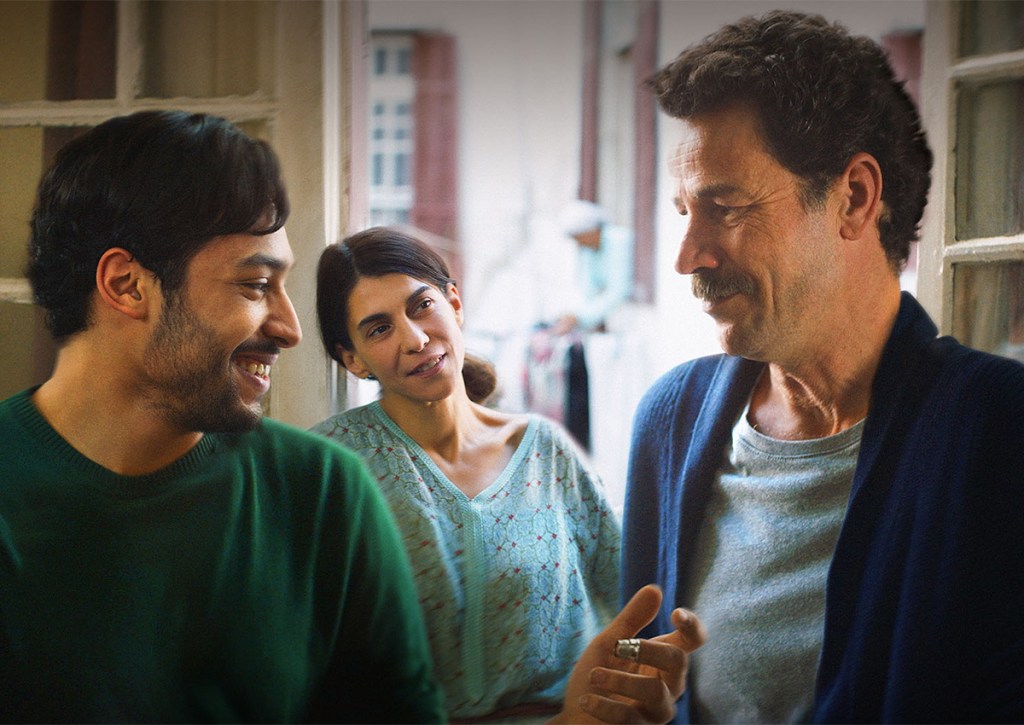
A gentle, sensual and compassionate Moroccan film about an unusual triangle that lingers in the heart and mind long after the credits, The Blue Caftan is a beautiful tribute to love.
Halim (Saleh Bakri), a middle-aged man with bashful eyes and soft melodic voice, is more than your average tailor. Trained by his father, he is a true master craftsman who makes bespoke women’s caftans at the traditional shop in a Moroccan medina. Halim refuses to use a sewing machine, and spends long hours working painstakingly on his exquisite, hand-embroidered masterpieces, while his ailing but dominant wife Mina (Lubna Azabal) runs the front.
In the increasingly impatient modern world, there’s less and less appreciation for Halim’s laborious artistry, and a shrinking pool of young people eager to learn the traditional ways. When a young apprentice, Youssef (Ayoub Missioui) joins the shop to help speed up the orders, Mina scornfully predicts that he’ll never stick around.
There’s another reason for Mina’s sharp-edged manner towards Youssef: she’s aware of the almost immediate attraction between her husband and the handsome young apprentice. Halim is gay, and in his spare time, he visits the nearby hammam where he finds relief for his suppressed desires in wordless sexual liaisons with anonymous men. Mina knows about his sexuality, and initially you’d be forgiven for assuming that their marriage is nothing but a polite, miserable sham. When Mina’s health takes a turn for the worse, the film slowly peels the layers of their relationship, and the dynamics between the trio shift in unexpected and profoundly moving ways.
All the while, Halim is working on the titular blue caftan (petroleum blue, specifically) commissioned by another fussy and impatient customer, stitch by stitch. His love of craft and beauty is conveyed in the many sensual and luxurious close-ups that linger on the sumptuous fabrics and intricate embroideries, and in many ways the film itself is a reflection of Halim’s patient, time-consuming method. It unfolds gently and slowly, with a steady concentration on the day-to-day and small details, a brush of a hand or a fleeting glance. Save for rare moments, its characters are not given to self-expression or speeches, revealing their feelings and emotions through everyday actions and gestures.
Because of this understated approach and intimate focus on the interpersonal relationships, I felt I could rest easy in the knowledge that no one was likely to be dramatically arrested and exposed for a behaviour considered illegal in a conservative society. The film is also relatively easy on the viewer where Mina’s slow deterioration is concerned, partly thanks to the vitality and feisty, indomitable spirit of Mina herself. Though it doesn’t overtly aim for the social commentary, the film does end with a powerful scene of defiance, born out of a desire to be true to oneself.
My upcoming trip to Morocco later this year definitely played a part in luring me to the cinema for the first time in months. It’s always fascinating to get a look inside a very different culture, where things are at once familiar and universally human, and yet removed in so many startling ways.
 yggdrasille.com