

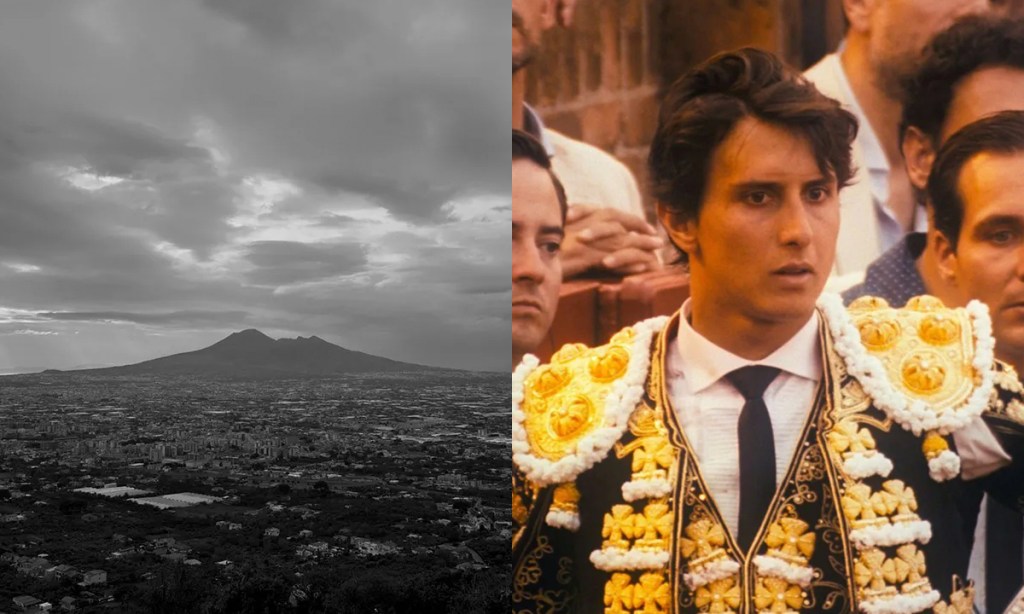
The festival of European cinema is on in Melbourne, and so far I’ve seen a couple of unusual documentaries: a meditative portrait of the city of Naples that’s both beautiful and unglamorous, and a fly-on-the-wall look at a bullfighting superstar and the controversial Spanish custom.
I’ve never visited Naples and my perception, formed from Elena Ferrante’s novels and other people’s travel stories, is that of a city that’s rough, tough and gritty, dangerous even. This documentary is no touristy reel and does nothing to dispel this impression, but its stunning black-and-white cinematography makes for a striking look at the city living in the shadow of Mount Vesuvius.
Vesuvius of course spewed up volcanic ash that buried nearby Pompeii in the catastrophe of AD79. The film devotes some time to the ongoing archaeological digs, and the dark silhouette of the volcano feels like a constant menace hanging over the place. It’s hard not to think of those who perished nearly two thousand years ago during the scenes in which worried citizens report the tremors.
Vesuvius is not the sole focus of the documentary, which floats between different perspectives: from the basement of the local museum where statues and artifacts from all historical periods lie in ghostly silence, to the worn-out emergency centre workers taking calls from all over Naples. One minute you’re with the officials exploring the many tunnels dug up by the thieves and tomb robbers, next you’re with the Syrian crew onboard the container ship bringing tonnes of grain from Odessa (the slow-motion footage of the flowing grain is one of the film’s most unexpectedly beautiful images).
You could call it artsy and pretentious and you wouldn’t be far off, but Below the Clouds felt like a very distinctive, disquieting and dream-like experience interweaving past and present, and a world away from the conventional images of sun-kissed Italy.
I was happy to skip live bullfighting when in Seville many years ago, and it’s safe to say that this documentary about the Peruvian matador Andrés Roca Rey didn’t change my mind about the gory spectacle, which is not downplayed or softened in any way. I did appreciate the fact that Afternoons of Solitude doesn’t seek to make a statement or force a view. Its approach is purely observational, following Rey as he goes on about what must be one of the strangest jobs in the world, leaving room for whatever personal feelings you have about it.
The documentary is all about immersion rather than information. There are no interviews and no narration; it’s up to you to make sense of the rules and rituals of bullfighting, and the tasks performed by the other men before it’s time for Rey to step in and do his stylised dance with the bull. You learn nothing about Rey’s past or family, his motivations for doing what he does, or his life outside bullfighting. The perspective is reduced to basically three settings: the arenas, the interior of the van taking Rey to and from fights, and the various hotel rooms. In one of the most memorable scenes, Rey puts on one of his magnificently elaborate costumes and his assistant literally lifts him up to make him fit into his tight pants.
Rey’s team banter non-stop when they have a chance, showering compliments on the man and praising his cojones (I seriously can’t remember a film with this many mentions of balls). Rey himself remains an intense, laconic and opaque figure, a fascinating cipher, always apart even when surrounded by people. He’s clearly a man of strong religious faith, and that’s about the amount of personal detail given away.
As for the action in the arena, it is closely captured, intense, brutal, both repellent and fascinating. It feels like a throwback to the ancient pagan past and the rituals of Crete and Rome, horribly cruel but not without a certain primal power. There’s a repetitive feel that I’m certain is deliberate, but after watching a few close encounters where Rey gets almost trampled or impaled by the animal, you never become complacent, that’s for sure.
 yggdrasille.com