

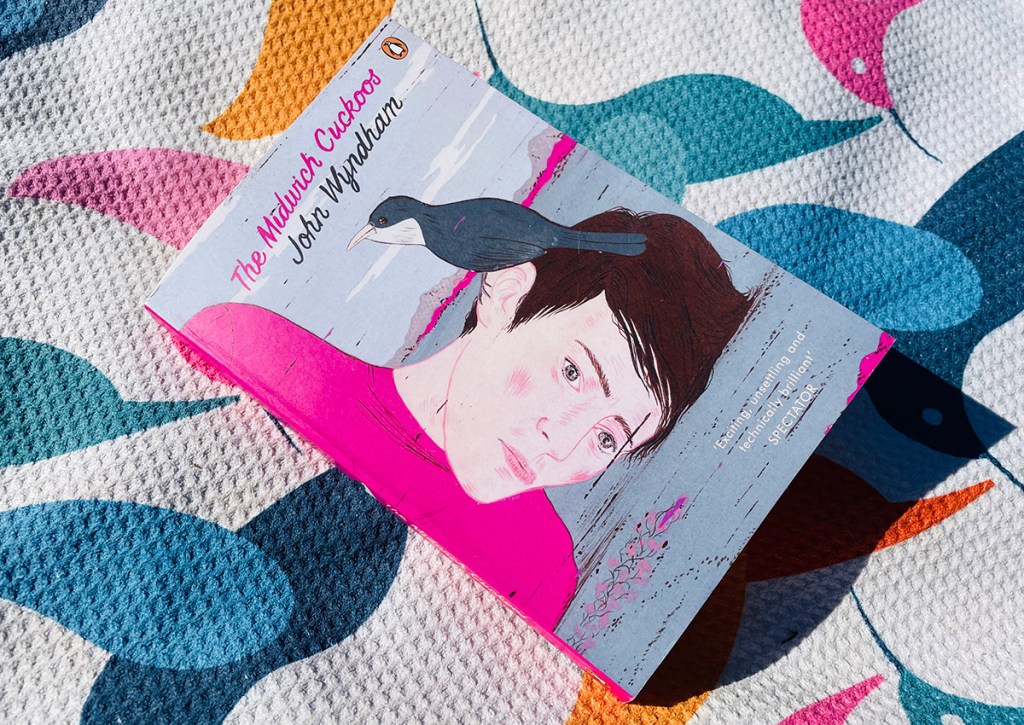
This 1957 sci-fi novel about a very different kind of alien invasion raises questions about morality and survival, and has some of my favourite genre tropes: small English villages and weird creepy children.
Midwich is the kind of unremarkable sleepy village where nothing ever happens… until one day it’s visited by a mysterious, otherworldly silver object that renders every living thing within a one mile radius unconscious. It vanishes the next day, leaving Midwich residents mostly unharmed and the British Military Intelligence utterly baffled. Just as normality returns and the event begins receding from memory, the village makes a shocking discovery: every woman of childbearing age finds herself pregnant.
At this point, I half-expected the story to skip quickly to births, but the first half of the book deals extensively with these inexplicable pregnancies and their effect on the community. After some initial confusion, anger and blaming, Midwich quickly rallies together, determined to keep the matter private and avoid becoming sensation fodder for the whole world. The women react differently: some are ecstatic at the prospect of a child, while others desperately resort to the old folk practices (the novel was published roughly a decade before abortion was legalised in the UK). Some women keep it together in public, but are scared and distraught in private. The topic of unwanted pregnancy has been explored more thoroughly in other books, but I have to credit Wyndham for not ignoring the emotional implications altogether.
Children, when they’re born, appear to be human at first, except for their striking golden eyes. It soon becomes obvious that they have nothing in common with their parents, or in fact the human race. They seem to possess a collective hive mind, leading some to speculate that they’re dealing with only two individuals, one male and one female, Adam and Eve if you like. Even as babies, they manifest frightening powers, imposing their will on their parents and compelling them to return to the village when some attempt to leave Midwich. Those who observe them closely begin to wonder what is to be done about these beings when they may prove to be impossible to control.
This uncomfortable question comes to the fore in the second half, where a few years have passed and the Children, as they come to be known, are developing at an accelerating rate and are divided from the rest of the village. They do not appear to have a malicious intent towards humans, and when violence does ensue, it’s an extreme reaction to what they perceive as a threat. Though clearly superior to humans in many ways, they are still immature children.
The dilemma for humans is, should they stick with the civilised morality and risk potential future conflict, even subjugation, or should they just admit the nature of nature and competition between species, and take care of the situation permanently? These are tough moral questions with no easy answers, and the characters’ many philosophical speculations and discussions were some of my favourite parts. The last half of the book also expands the scope and explores the impact of the Children beyond Midwich, in the Cold War era that understandably casts a shadow over the whole story.
Speaking of characters, the reason I haven’t mentioned any so far is that they mostly serve to move the plot forward and explore the big ideas, as is the case with many sci-fi novels. The narrator, a recent resident of Midwich with handy connections to the military, is fairly bland and nondescript; the most developed character here is Gordon Zellaby, an elderly local scholar who first picks up on the Children’s unusual abilities and attempts to understand them. Zellaby’s younger wife and daughter play an important part in the first half, but then pretty much disappear.
Despite the lack of memorable characters, I really enjoyed Wyndham’s very British, very wry and dry style, with many witty lines and the kind of understated humour I love. He has a way of writing about disturbing events and scenarios in a calm, measured way that doesn’t downplay the disturbing factor and yet makes the book feel light. I don’t often bring sci-fi as a beach read, but I actually got through a lot of The Midwich Cuckoos in my beach chair during the recent hot days.
 yggdrasille.com