

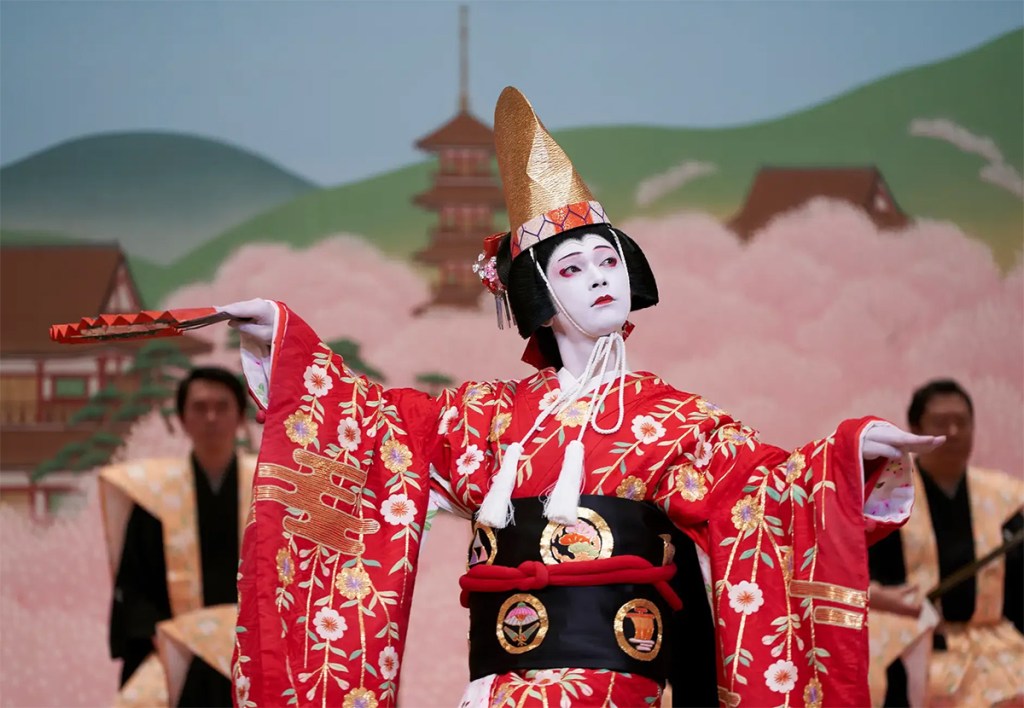
Despite the hefty running time of three hours, I was spellbound by this Japanese epic set in the beautiful, brutal world of kabuki theatre.
My only personal brush with the classical Japanese theatre happened on my first trip to Japan, when our tour group watched one act of a kabuki performance in Tokyo. It remained in my memory as a fascinating experience that was completely impenetrable to a foreigner, probably similar to going blind into a Western opera for the first time and getting a massive culture shock. I also either didn’t notice or completely forgot about the kabuki tradition of male actors – onnagatas – playing female roles, which as the movie’s prologue explains originated with the 17th-century shoguns forbidding women from performing.
I’ve always loved movies and stories about the pain and ecstasy of art, told with a sort of operatic intensity. Kokuho covers fifty years to tell a story of incredible highs and lows of two aspiring kabuki actors. It opens in 1964 Nagasaki, in a middle of a New Year’s banquet held by a local yakuza. Hanjiro Hanai (Ken Watanabe), the renowned kabuki performer, happens to pay a visit. He is instantly impressed by the talent of his host’s teenage son Kikuo, who performs the female role before his proud father and guests. On the same night, Kikuo’s father is brutally murdered by a rival, and after a failed attempt at revenge Kikuo is sent to Osaka to learn the art of kabuki from Hanjiro.
Hanjiro’s son Shunsuke, also studying to be an onnagata, is not exactly thrilled with the yakuza orphan. Still, the two boys quickly bond, beginning a friendship and rivalry that will last many years, with many dramatic reversals of fortune for both. Kikuo (played by Ryo Yoshizawa as an adult) blossoms under the harsh and physically punishing tutelage, but he can never ever forget his outsider status in the rigid, hierarchical world of kabuki where bloodlines rule. As Hanjiro’s son and heir, Shunsuke (Ryusei Yokohama) has a golden pass, but he’s increasingly aware that his father doesn’t rate his abilities as highly as that of his friend and stage partner.
Kokuho doesn’t always flow smoothly and has a few underdeveloped subplots, usually involving women in Kikuo and Shunsuke’s lives; Kikuo’s illegitimate child with a geisha seems to be in the movie solely for the purpose of one crucial scene in the finale. However, the two compelling leads and their rollercoaster relationship never once faltered. Yoshizawa is especially magnetic as Kikuo, beautiful, enigmatic and somehow not quite of this world even when offstage. At times, his ferocious ambition and willingness to pay a price for his art lead him down questionable paths, which adds an intriguing layer to his character. His place in kabuki is always fragile, always dependent upon the goodwill of sponsors and respected elder statesmen.
Where the movie absolutely soars and sings is during the many immersive scenes of kabuki performances, with the male actors transformed into otherworldly creatures, embodying idealised femininity through elaborate costumes and stylised acting and dancing. The magic of cinema and the sense of intense personal stakes for the characters make what could have been an inaccessible art form an engrossing, emotionally engaging spectacle. The physicality and passion of it all as captured by the camera up close moved me, where a real-life performance as seen from afar perhaps wouldn’t have.
It was also immensely helpful to have a brief onscreen summary of the narrative behind every dance or play in English, for the non-Japanese audience. Next to these tragic, over-the-top stories of love and death, the melodramatic twists and turns of the characters’ lives felt quite natural.
 yggdrasille.com