

The sequel to the zombie classic may be messy and disjointed, but I always have time for flawed oddball movies that take chances, even if they bite more than they can chew.
These days I rarely go into a movie without knowing the reaction it earned from the audiences and my favourite movie critics. In this case, I was glad that the extremely divisive reception of Danny Boyle and Alex Garland’s movie helped temper my expectations, which were pretty high after that stunner of a trailer. Nothing could have prepared me for the most baffling and jarring ending I’ve seen in years, but I still felt better equipped to handle the movie’s scattershot storytelling.
It’s now been nearly three decades since the rage virus turned the United Kingdom into a post-apocalyptic hellscape. Rather than returning to London, the action shifts to a place in North East England called Holy Island, connected to the mainland by the causeway that’s only accessible during low tide. Outside of this safe haven, mobs of bloodthirsty infected roam, with the entire country quarantined from the rest of the world and survivors left to fend for themselves.
The first act does a compelling job introducing the ways and rules of this isolationist community, with its medieval weaponry and a portrait of Queen Elizabeth II overlooking the town hall. We also meet our hero, 12-year-old Spike (Alfie Williams in an impressive and naturalistic debut). Spike’s mother Isla (Jodie Comer) is bedridden with a mysterious illness that often leaves her confused and disoriented. Meanwhile, Spike’s dad Jamie (Aaron Taylor-Johnson) is ready to take him on his first zombie hunt, a tradition for the local boys.
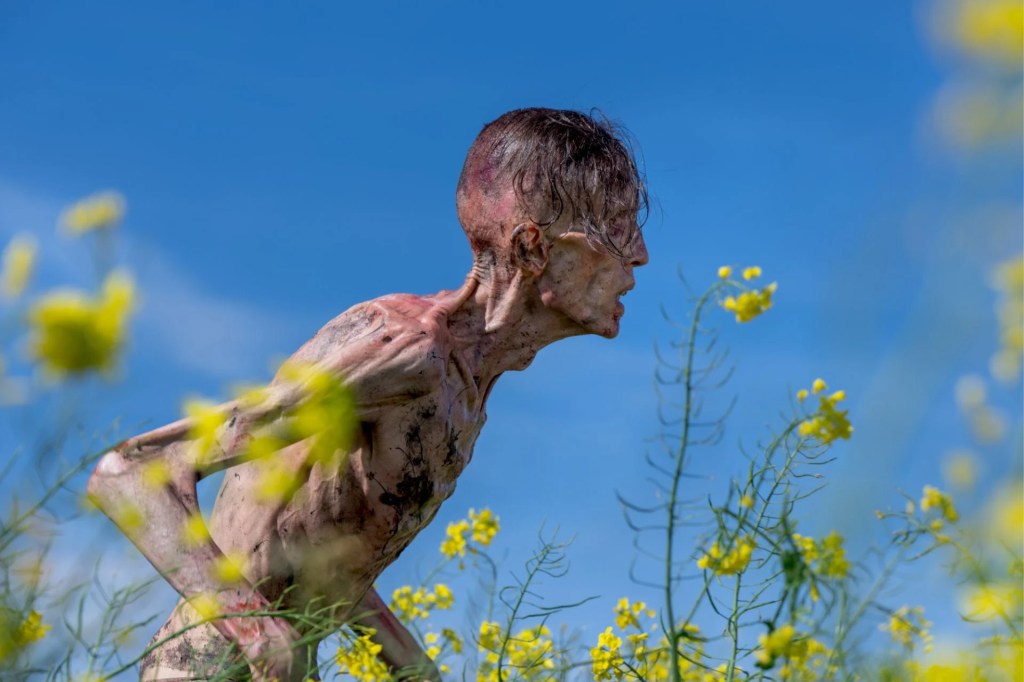
The lush green countryside Spike and Jamie venture into is as dangerous as it is beautiful, and the hunt reveals some key details about the world 28 years later. Over time, the virus victims have evolved into several sub-groups. There are grotesquely swollen slow zombies, crawling on their bellies and enjoying a diet of worms, a fairly easy kill. There are also Alpha zombies, bigger, faster, more intelligent and, um, more endowed than your average infected.
Despite being perhaps more conventional and familiar, this nightmarish, grisly rite of passage is the part of the story that works best. Some of Boyle’s fast editing gimmicks made me wish they were left where they belong (early 2000s that is), but there’s no denying the distinctive, pulsating energy he brings with his kinetic camera movements. This is also the first time I got sold on Aaron Taylor-Johnson, who has a wonderful rapport with his young co-star. Then, when Spike happens to learn about a reclusive, possibly insane doctor (Ralph Fiennes, always a reliable scene-stealer) who could cure his mother, the story pivots away from the father-son dynamic into a sort of demented road trip to meet the healing wizard. Along the way, Spike and his mother have all sorts of encounters, some friendly, some grotesque, bizarre and dangerous.
Though 28 Days Later is hands down a much better movie, there’s something about the beautiful, poetic, ethereal and violent world of the sequel that in some way drew me in more. It feels more mythical and folk-horror, often drawing on religious imagery both sacred and ghoulish. Also, overrun with rage zombies or not, I can’t help but respond in a very primal way to the green English countryside and fields of yellow wildflowers under a brilliant blue sky. I can’t say that I found the infected scary, but there are still plenty of well-executed, tense scenes full of visceral horror.
It’s just a shame that Boyle and Garland’s story doesn’t quite live up to its setting. It felt very much like the two wrote down every single idea they had for this movie, and then decided to cram them all in without doing much more than scratching the surface. Their penchant for sharp left turns also means that characters and their relationships never fulfill their potential. The mother-son storyline felt especially thin and lacking, and what should have been heavy, affecting emotional drama near the end left me indifferent. This is no fault of Jodie Comer, who is an excellent actress doing her best, but her character just never really gelled together for me.
At the same time, this chaotic and dissonant feel was a part of the film’s weird charm, as was the utterly bonkers ending, a complete tonal whiplash that probably sunk the entire film for many people. It both brings things full circle in a way I did not anticipate, and potentially introduces a major character for the next film in the planned trilogy. It doesn’t really work and yet I dug its sheer ballsy eccentricity, as I did the movie’s wilfully shambolic nature overall.
 yggdrasille.com