

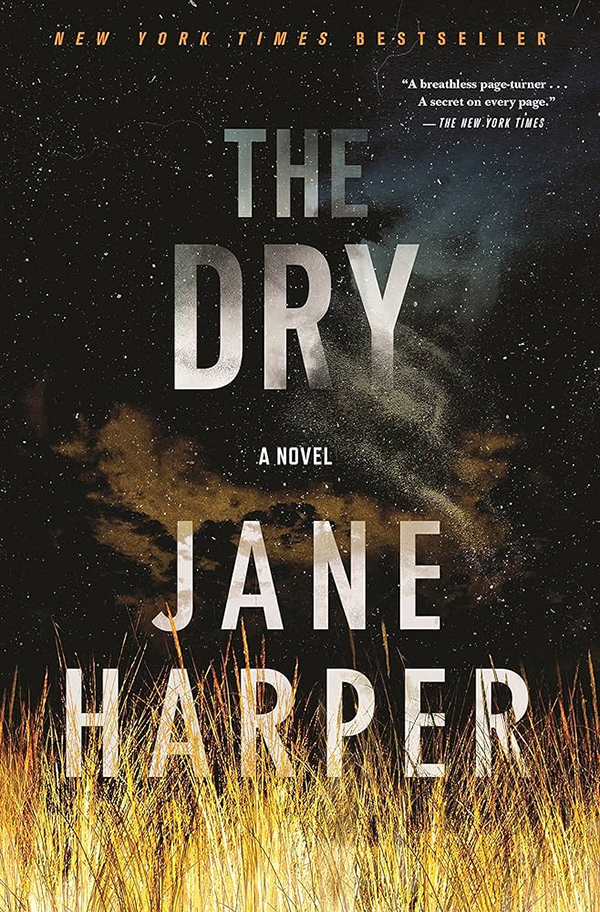
I haven’t read Australian fiction in a while, and I quite enjoyed this solid, well-written crime novel set in regional Victoria during an unrelenting drought.
I more or less finished The Dry in a day while recovering from a cold, and found it a perfect book for bed rest: easy to read, gripping and twisty enough for me to keep going through a mild mental fog. Modern crime fiction is a genre I only sporadically dip into, but this debut from a former journalist had an attractive quality of being set in my own corner of the world, and having a distinctly Australian feel.
As a city dweller, I’ve mostly experienced drought through the water restrictions (in fact I still have the habit of never leaving the water running uselessly while showering in the morning, remembered from a particularly bad summer many years ago). For a small farming community like Kiewarra, no rain for months is hell on earth, sucking the life out of the town and driving people to the brink of despair. When a local farmer Luke Hadler is found dead after apparently shooting his wife and son first, the town is shocked but not altogether surprised that one of their own went off the rails.
Attending the tragic triple funeral is Aaron Falk, Luke’s old childhood friend, now a financial investigator with the Melbourne Police. Falk doesn’t plan to stay for long: twenty years ago, he and his father were driven out of Kiewarra over the death of a teenage girl, ruled a suicide at the time. A plea from Luke’s parents leads him to be reluctantly drawn into the investigation, joining forces with a local Sergeant who has his own serious doubts about Luke’s guilt. But Falk’s probing disturbs old wounds and hostilities, resurrecting the rumours about his hand in the death of Ellie Deacon in a community already set on edge.
Harper’s writing is perhaps not quite as atmospheric as I hoped for after getting punched in the gut by the brutal, vivid prologue, which sets up a horrific scene of death in the middle of a drought. I suppose it’s hard to stay atmospheric when the more prosaic and dry language of investigation, facts and clues take over the story. She still manages to conjure up a broadly familiar yet specific place with telling details: a lifeless main street full of empty shops, depressing children’s drawings at a local school with brown as the predominant colour and smiles turned upside down.
Many novels extol the virtues of a closely knit small town, but The Dry is not one of them. Seen through Falk’s eyes, there’s an unpleasant, poisonous streak running through Kiewarra, a sense of wrongness that extends beyond the local bullies and the pressure of the heat. Interestingly, you also don’t get an impression of Falk’s single life back in Melbourne as particularly fulfilling. Was he ultimately better off for escaping life in an insular, intense community, at the mercy of neighbours and nature, or could he have had a happy family life in Kiewarra after all?
The book may not be a fast paced thriller, but its slowly unfolding mysteries, past and present, still drew me in and kept me guessing. A chapter would often end with a teasing hook, a simple trick for sure but hey it kept me turning pages. Harper does a good job dropping small nuggets of information through the use of flashbacks, which force the viewer to constantly reassess their opinion of characters. A couple of twists relied too much on overused tropes for my liking, however I admit I was almost completely blindsided when it came to the identity of the murderer. It all builds up to a nail-biting climax that’s dramatic without being overwrought, and resolves various threads in a satisfying way.
From what I gathered The Dry is the first novel in the Aaron Falk series, and I would definitely be up for more Jane Harper mysteries.
 yggdrasille.com