
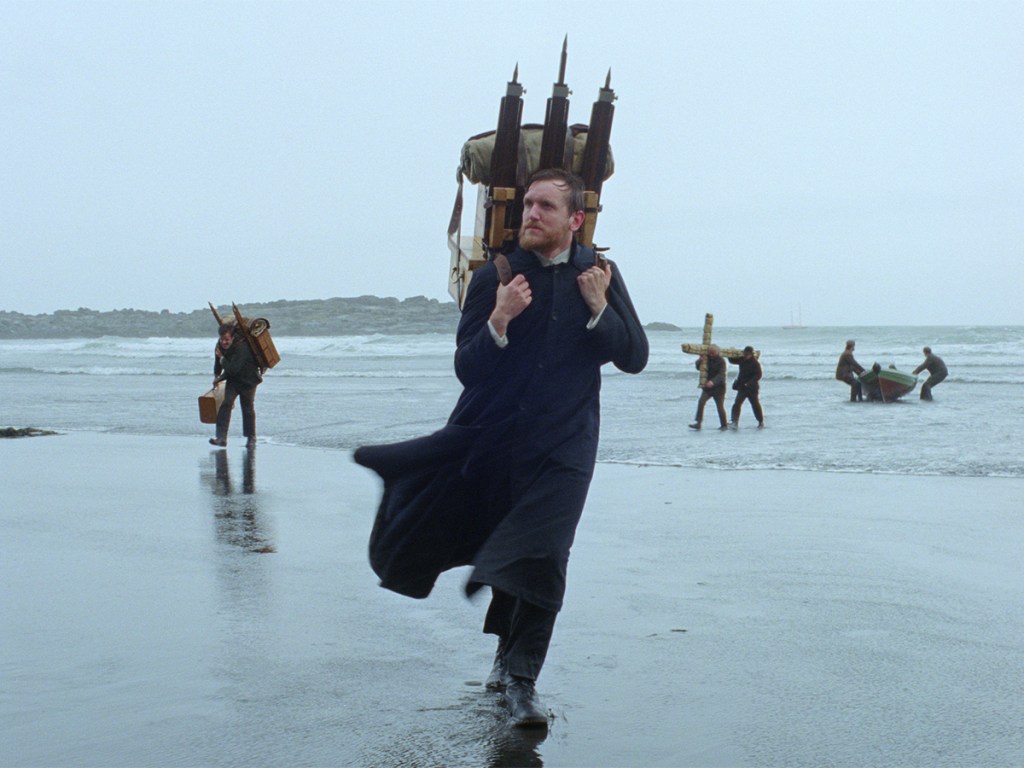
The vast, harsh landscape of Iceland is beautiful and terrifying in this extraordinary film about a 19th-century Danish priest tasked with establishing a new church in a remote corner of the country.
I am a simple woman: I see a movie set in Iceland promising tons of landscape porn, I say yes please. The best chance to see Iceland on the big screen in Melbourne is during the annual Scandinavian Film Festival, and this year I was lucky to catch a couple of Nordic delights, including this third feature from writer-director Hlynur Pálmason, an Icelandic native who studied filmmaking in Denmark.
The film is shot in the almost square 1.33:1 aspect ratio, which might sound like a curious choice for a movie involving majestic landscapes that you’d think demand the widest screen possible. This format however ties in with another mission of Lucas (Elliott Crosset Hove), the Danish Lutheran priest sent by his bishop to a community on Iceland’s south-eastern coast. He brings with him a bulky tripod, in the hopes of capturing the people with this new technology. Like Lucas’ photographs, the unusual boxy screen feels like an intimate peek into a distant past and a way of life long gone since.
Lucas’ choice of travel is so arduous it’s borderline masochistic. After a vomit-inducing sea crossing, his small party treks the land on horses, across desolate mountains, dangerous rivers and icy, inhospitable plains. I rarely go into a movie with preconceived ideas, but here I assumed that the hapless priest was never going to make it, and that I was going to see another tragic tale of human arrogance and conceit crushed by the unforgiving forces of nature. Sure enough, the journey takes Lucas to the very brink of physical and spiritual exhaustion, but to my surprise there was a second, very different half of the movie set in the small coastal parish, where, after recovery, Lucas gets to oversee the construction of the church.
Likewise, I didn’t expect to see the hostile Icelandic landscape find embodiment in the shape of Ragnar (Ingvar Sigurdsson), a tough, proud Icelandic guide hired to take Lucas to his destination. With his weatherbeaten face and confident knowledge of the land, Ragnar seems at one with the harsh natural environment, and he can barely hide his scorn for the clumsy, bookish Dane he’s saddled with (you also don’t need to be closely familiar with the complicated history between the two countries to pick up on the strong colonial themes).
At the settlement, however, there’s a significant shift in their dynamic, with Ragnar somewhat diminished and forced to endure casual insults from Lucas’ slyly shrewd host Carl, and Lucas no longer having to rely on Ragnar for survival. The undercurrents of mutual hatred and resentment are always close to the surface, and the spectacular scenes of a volcanic eruption hint on an explosive end to the two men’s conflict.

As a protagonist Lucas is pretty tough to warm up to, with his sour, dour disposition and arrogant attitude that costs lives along the journey. Later in the movie, he has a romantic connection with his host’s daughter Anna, and lighthearted interactions with Anna’s cheeky younger sister Ida, which bring out a softer, more sympathetic side. Overall though I got an impression that the movie treated its characters less as traditional characters, and more as the means of exploring the tension between Denmark and Iceland, religion and nature, and tragedy that comes from the gulf in understanding and refusal to cross it.
Once you settle into the movie’s own peculiar rhythm, it’s hard not to be dazzled by its artistry and sense of composition, which is much more than just taking pretty shots of the stunning scenery. The most striking sequences are montages of changing seasons that serve as stark, brutal reminders of the natural process that’s bound to happen to us all. There’s also a couple of remarkable 360-degree tracking shots, which move so slowly you have no choice but to fully take in the sights and sounds: one of a valley where Lucas lies seemingly close to death while the light changes and birds trill all around, and another that takes in wedding festivities to the sound of accordion played by Ragnar.
I missed out on Pálmason’s previous movie A White, White Day after it got lost in the chaos of the pandemic, but on the evidence of Godland he definitely looks like a talent to watch.
P.S. I can’t end the review without mentioning Ragnar’s gorgeous Icelandic sheepdog, who was awarded Grand Jury ‘Canine Cast’ Palm Dog at the Cannes Film Festival! This Good Boy may not actually do much for most of the film, but he plays a surprisingly important role in the climax that I didn’t see coming.
P.P.S. The scenes in which Lucas develops his photos reminded me of my childhood and the many hours I spent watching my dad at his photography hobby. I remember being mesmerised just watching the images slowly appear as if by magic.
P.P.P.S. During the movie, you get a few graphic reminders that back in the day, meat didn’t come from a supermarket, which made more than a couple of people in my theatre wince.
 yggdrasille.com