

This bittersweet character study is all about the pleasure of witty dialogue and Ethan Hawke’s knockout performance as Broadway musical legend Lorenz Hart.
I went into this movie knowing very little about the history of classic Broadway. I’m at least familiar with the names of Rodgers and Hammerstein, and I heard about Oklahoma!, the first musical written by the duo. I did not know that Rodgers was also a long-time half of another influential partnership with the lyricist Lorenz Hart, who is the focus of Richard Linklater’s film, taking place on the evening of March 31, 1943.
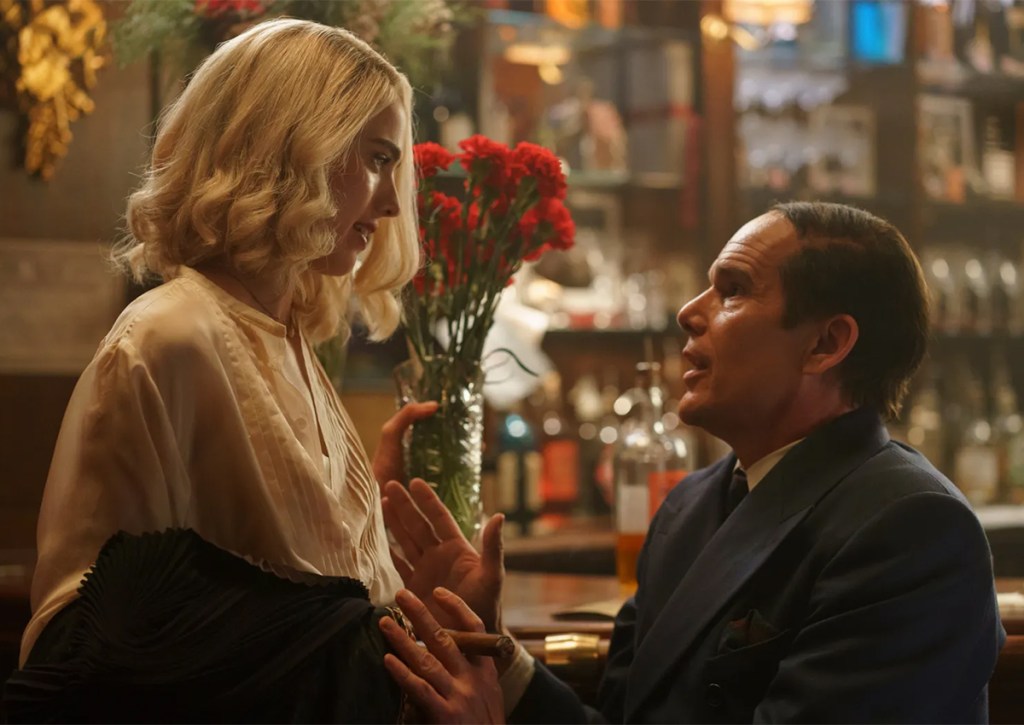
It is the triumphant opening night of Oklahoma!, and it’s also one of the last nights in the life of Lorenz Hart, who is seen collapsing drunk in a rain-drenched alley in the prologue that foretells his death just a few months later. Hart attends the show, but can’t bear to stay till the end and leaves early for the bar where the after-party will take place. He rather dreads the reunion with his old writing partner, but he is absolutely ecstatic about his chances with Elizabeth (Margaret Qualley), his young protégé and a Yale student. Yes he’s a head shorter, twenty-seven years older, and is a self-destructive, balding alcoholic on a downward spiral who most people believe to be gay… but a man can dream, and so does Hart, desperately.
Blue Moon does a beautiful, atmospheric recreation of a tiny slice of 1940s New York. However, this is a movie where dialogue is king and lifeblood, with Hawke’s Hart onscreen for almost the entire time and talking nearly non-stop. He’s an eloquent wordsmith who adores language, flamboyant, intelligent, erratic, and very much teetering on the edge, with his best days far behind him. He is both infuriating and profoundly sad, a flawed genius pushed out of limelight because of his own personal failings.
I always found Ethan Hawke somehow both likeable and annoying, and so he’s a perfect choice to play a character who irritates you and makes you hang on every bit of wordplay and lightning-fast wit that comes out of his mouth. I’ve generally grown fonder of Hawke with years, but I’ve never seen him better than here, giving the kind of tour de force performance where the actor disappears into the role, inhabiting it with such depth and understanding that you can’t see anyone else play the character.
Hawke has a terrific chemistry with the handful of supporting players, and Blue Moon changes up rhythm in his scenes with Elizabeth and Rodgers especially. Margaret Qualley is enchanting and magnetic in her brief appearance, and looks believably like a 1940s beauty; her admiration of Hart feels real but she also obviously sees him as a way to get her foot in the door. Hart becomes a listener for once in their crucial, heartbreaking scene.
Andrew Scott, whose uneasy presence was unforgettable in Ripley TV series where I saw him last, plays against the type and brings subtlety as a “normal” foil to Hart. Rodgers is a mix of respect and resentment where his old writing partner is concerned. He knows that he owes Hart a great deal, but he cannot stand his lack of discipline and the urge to be satirical and irreverent about everything under the sun. In some ways, Blue Moon is a break-up movie about two people who revere each other but can’t be together.
I think of cinema as a primarily visual art form, but I also have a lot of love for the talky, one-location movies that could almost be a theatrical play, and live or die on acting and words. Despite its self-imposed limitations, Blue Moon pulses with energy, humanity and life, and I loved spending time in its small universe.
P.S. Though ignorant about the partnership, I realised that I knew at least a few Rodgers and Hart songs, My Funny Valentine, The Lady Is a Tramp and yes Blue Moon.
 yggdrasille.com