

Can a disappointing film be redeemed at the last stretch by a powerful ending that finally gets to you? In case of Chloé Zhao’s historical drama about the possible heart-rending origin of William Shakespeare’s Hamlet, I’d have to say, not really.
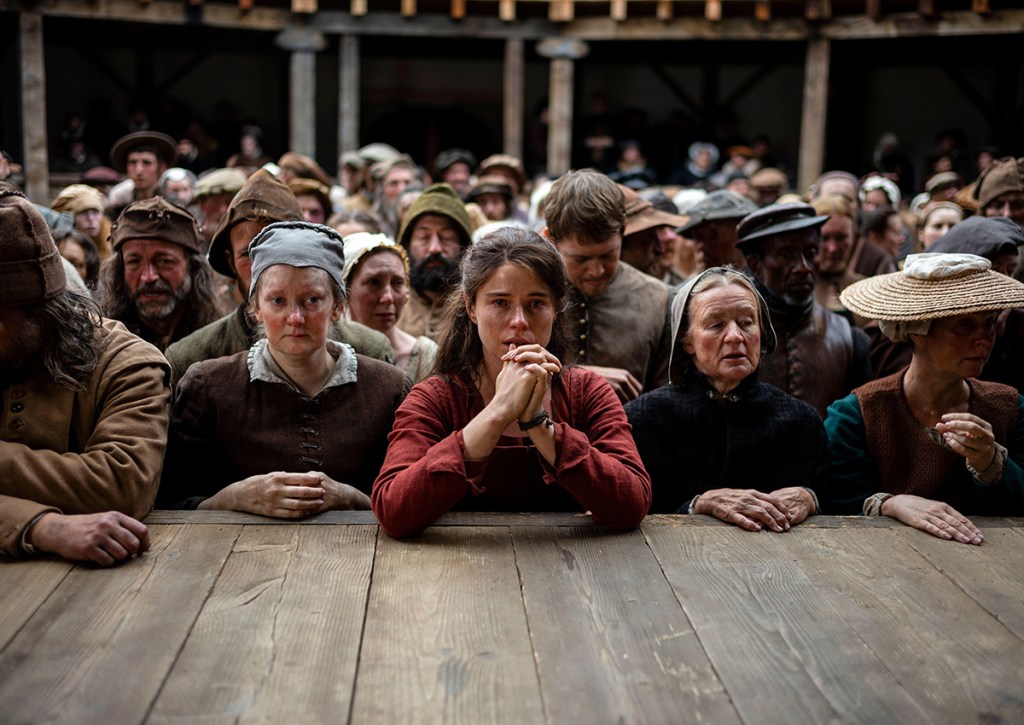
Hamnet did make me interested in Maggie O’Farrell’s “what if” novel of the same name, which pinpoints the death of Shakespeare’s eleven-year-old son Hamnet as the beginning of his immortal tragedy (Hamlet and Hamnet, according to the movie’s prologue, were interchangeable near the end of the 16th century). Fictionalised or not, the idea of art as an opportunity for healing, a place where deep personal pain can transform into a rich resonant work with universal appeal, is a compelling one. The movie did come alive to me during the go-for-broke climax taking place at the Globe Theatre, but I couldn’t forget the flatness I felt for the rest of it.
We first meet Shakespeare’s future wife Agnes (Jessie Buckley) as she wanders the forest with her feisty hawk, looking every bit a magical woodland nymph in a red dress. Back home, Agnes is rumoured to be a witch like her late mother, but her reputation is of no matter for Will, an aspiring poet who like Agnes chafes against the rigid expectations of society and family. They flirt and frolic, and eventually marry when Agnes falls pregnant.
Agnes has a vision of herself dying with two children, but the couple go on to have three: first a daughter, then twins, a boy and a girl who is stillborn before Agnes breathes life into her. The vision however turns cruelly true when plague carries off young Hamnet while Will is in London chasing his dream. Though she herself had encouraged his ambitions, Agnes blames her husband for not being around, and the relationship fractures as the two parents try to deal with the agony of grief in their own ways.
Hamnet was an incredibly frustrating experience for me, because it has so much going for it. Chloé Zhao, who did a wonderful job with Nomadland, has a strong feel for nature and the lived-in, tactile physical world that her characters inhabit. The lush green of the forest, mossy ancient trees, thick brown mud, rough wood of the dwellings all feel almost within your reach in this gorgeously shot film. I’ve yet to see Jessie Buckley in a performance where she doesn’t feel hundred percent present and alive; her crooked smile and the raw emotion that seems to burn through her skin are a marvel. Whatever problems I had with Hamnet, her acting here deserves to be showered with awards. I also enjoyed the always-wonderful Emily Watson as Will’s mother, and Joe Alwyn as Agnes’ quietly supportive brother.
Having not read the book, I can only speculate on how much was lost onscreen in translation, without the novel’s language and interior lives of the characters. Vibes and sensory experience aside, the film feels slight and wispy, its characters and relationships superficial. Zhao’s intent here is clearly to make these historical figures as close and relatable as possible, and put us right in the centre of their emotional upheaval. But I never felt like I got to really know the family, including poor doomed cherub-faced Hamnet, and so when the tragedy struck I found myself in a position of a dispassionate onlooker, weirdly unmoved by the displays of grief and sadness. To be fair, I also tend to respond more to restrained emotion rather than guttural howling and wailing. At times, the film wallows in histrionics so much they actually took me out of the moment.
I was a fan of Paul Mescal’s nuanced work in Normal People and Aftersun, but now I begin to wonder if his range extends at all beyond the diffident, sensitive modern males that seem to be his specialty. He feels completely adrift here, chewing the scenery (badly) while attempting to show Will’s struggle with a writer’s block, and delivering the limpest, lamest version of Hamlet’s most famous soliloquy while apparently considering a suicide on the bridge, a moment so on-the-nose it made me groan. Mescal does have a few strong scenes, especially when William channels his grief into a tense, fraught rehearsal with theatre actors due to perform Hamlet, but these are not enough.
I understand that Shakespeare’s marginal presence in the book was expanded to a full lead, however I left the movie with no insight into one of the world’s most important literary figures beyond very broad strokes. It feels as if, in an effort to make Shakespeare more human, the film strips away any sense of extraordinary from him. Like many other film fans, I’ve always bristled at Shakespeare in Love winning Best Picture over Saving Private Ryan, but I’ll give it its due, it’s a much better William Shakespeare film than Hamnet.
 yggdrasille.com