

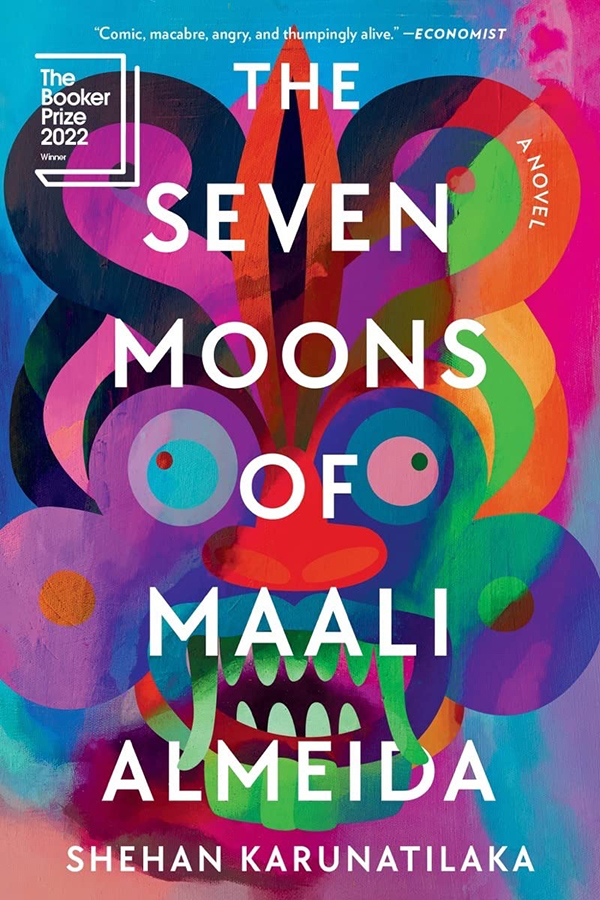
Set in the 1980s Sri Lanka, this macabre and darkly humorous novel is equal parts murder mystery, ghost story and political satire, brimming with energy, bite and wit.
I had something of a false start with the book: I tried to read it during my recent trip to Sri Lanka, before deciding that the carnage of the Sri Lankan civil war didn’t make for a good holiday read. Karunatilaka’s imagination and mordant humour did impress me, so I was happy to give it another go back home. It felt strange to have my fresh memories of Colombo overlaid with the violent and fantastical imagery of the 1989 Colombo, where the unsuspecting living share space with throngs of the dead.
“You wake up with the answer to the question that everyone asks. The answer is Yes, and the answer is Just Like Here But Worse.”
So begins the tale of Maali Almeida, beautiful and arrogant, a war-time photojournalist, debauched gambler, unfaithful lover, atheist and a gay man. He wakes up in the afterlife with no memories of how he has died or who is responsible, and discovers that the In Between has its own bureaucracy for processing recently arrived souls. Maali is informed that he has seven moons, or a week, to wander the world of the living and reflect on his life before he becomes forever trapped in the afterlife.
Maali however is not in a hurry to rush towards The Light and whatever comes next. For one thing he would like to solve his own murder. He’s forced to watch as his body is dumped in the Beira Lake by the garbage men – goons hired to dispose of the remains of the countless violent acts – but he knows that the trail leads much further than that. As a photojournalist and fixer who has worked with all factions of the conflict and documented the unspeakable atrocities they committed, Maali has the dirt on the corrupt officials who orchestrated these horrors. He doesn’t want his work to be consigned to oblivion, and somehow he must lead the people he loves and trusts towards the stash of photos hidden under his bed.
The spiritual realm of In Between has its own rules: you may travel with the wind where you’ve been before or where your name is spoken, but you can’t just fly to Paris or Maldives on a whim. It is populated with many victims of the civil war, still displaying their blood-stained clothes and horrific wounds, souls who for whatever reasons got stuck in the afterlife, ghouls, demons and terrifying soul-eating monsters known as the Mahakali. Some angry souls crave vengeance against those who have wronged them, including an insurgent who tries to convince Maali that the whole Light thing is a scam designed to make people forget and prevent any meaningful change. Maali may be right to fight against the collective amnesia, but there’s also a darker side to remembrance that can keep a war going.
Maali’s story is written in second person, an unusual choice that gives the novel a sense of urgency and also has a bit of a distancing effect. We learn about the gruesome acts of inhumanity he has witnessed, his life as a closeted gay man, his complex relationships with his mother, his best friend and pretend girlfriend Jaki, and the love of his life, DD, Jaki’s cousin and the son of a distinguished government minister. Maali is as world-weary as you’d expect someone in his position to be, and has many cynical things to say about his divided, chaotic country. But he’s also a romantic soul with a surprising idealistic streak, and a hope that his work can make a difference. He finds out that even in death, there are still moral choices to be made.
Maali provides a helpful list of the various parties and their abbreviations involved in the civil war, remarking that any search for good guys and bad guys is pointless. I confess that I still had trouble keeping track of the secondary characters and who belonged to which faction. My knowledge of the war hasn’t really been improved by my trip to Sri Lanka; it’s clearly a sensitive topic that our local group leader didn’t want to delve into.
There’s an exhilarating sense of vitality about Karunatilaka’s writing that compensates for the meandering, loose nature of the story; I never felt like it ran out of gas or lost momentum. He has a way of describing violence that made me wince on many occasions, but for a book full of death and gore it is also grimly funny, an intoxicating cocktail of dark comedy, romance, supernatural, politics and crime. Sometimes a novel can be undone by its ending, but Seven Moons really brings it home with a nail-biting, wise and deeply satisfying conclusion. After my recent mixed experiences with Booker Prize winners, this one truly deserves all the accolades it’s received.
 yggdrasille.com
I agree that it’s probably not something you want to read while visiting the country, but glad you got back to it. Excellent review.
LikeLiked by 1 person
Thank you!
LikeLiked by 1 person