

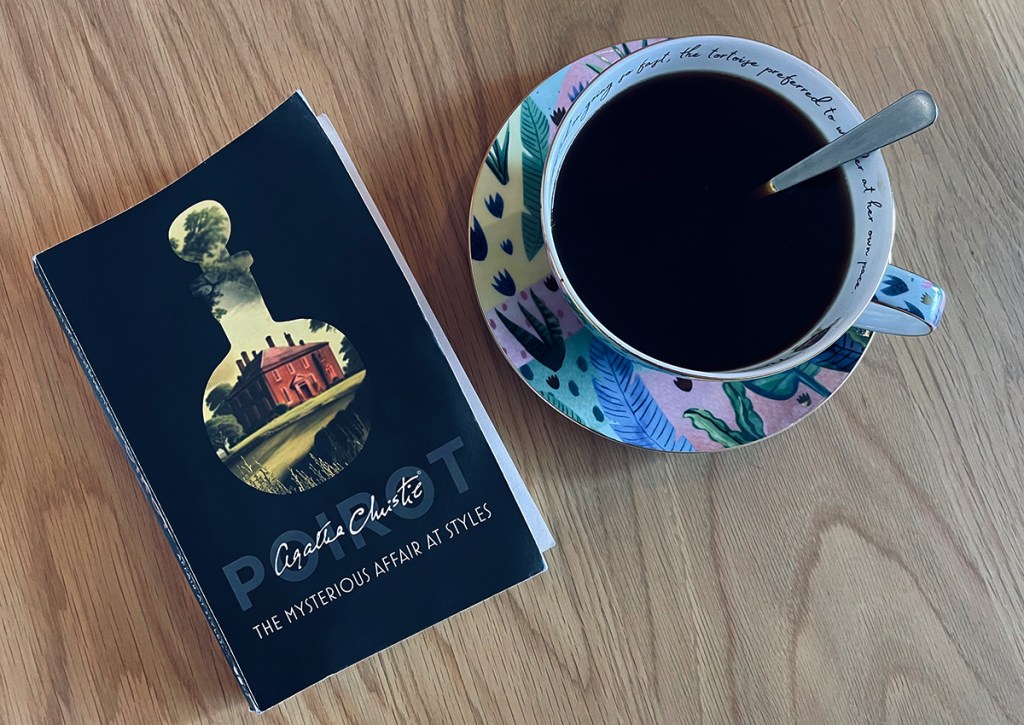
I did it: after five and a half years, and eighty novels and short story collections, I’ve finished my Agatha Christie re-readathon with the Poirot mystery that started it all.
Though I went about it in an unplanned and haphazard fashion, at the back of my mind I think I always planned to cap off my Christie odyssey with her first ever published novel. According to the introduction, The Mysterious Affair at Styles had origins in a challenge from Christie’s sister Madge, who dared Agatha to write a good detective story. Where would we be without our annoying siblings?
Set in 1917, the book is narrated by Captain Hastings, Poirot’s own Dr Watson. With a month of sick leave from the Western Front at his disposal, Hastings is invited by his old friend John Cavendish to spend time at Styles, his stepmother’s country estate in Essex. One morning, the horrified household wake up to find Emily Inglethorp, the elderly benevolent authoritarian of Styles, die from what is soon discovered to be a strychnine poisoning.
It’s not at all clear how the poison was administered, but the murderer could only have been one of the people staying in the house that night, which include Mrs Inglethorp’s two stepsons, John and Lawrence; John’s enigmatic wife Mary; Cynthia, a young friend of the family; and Mrs Inglethorp’s new and much-younger husband Alfred. By a lucky coincidence, Hastings’ old friend Hercule Poirot, a former shining star of the Belgian police force and now a war refugee, is living in the nearby village of Styles St Mary. On Hastings’ recommendation, Poirot takes up the challenge and puts his famous little grey cells to work.
Though The Mysterious Affair at Styles is never touted as one of Christie’s must-read masterpieces, it’s fair to say that the future Dame Agatha set a high standard with this accomplished debut. The plot might be a tad too busy with an overabundance of clues and some clunky moments, and for sure, her later novels would have mysteries that are sharper, more ingenious, more elegantly constructed and with greater psychological depth. Still, the clever and elaborate puzzle presented here is impressive, as well as Christie’s confident grasp on her effortlessly readable trademark style and light tone. Like many of her other novels, it takes a subtle notice of the world it’s set in and the rapidly changing social norms (such as new-fashioned female gardeners in breeches).
Of course this is also the literary debut of Christie’s beloved detective (influenced by the real-life Belgian refugees arriving in her home town during the First World War), and even in this early novel, Poirot already jumps off the page with all of his distinctive and endearing quirks. His character would be refined further in later books, but his detective methods, flamboyant personality, sentimental concern for lovers and immense confidence in his own judgement and abilities are already locked in. There are also hints of Poirot’s future dynamic with Hastings, with Poirot recognising the usefulness of his not-too-bright friend, though maybe not in the way poor Hastings would have preferred.
My edition of the book had an unexpected extra chapter: apparently, Christie was requested to amend the ending that originally had Poirot giving evidence and unveiling the mystery from the witness box at the trial. Instead, it was refashioned into the now-iconic drawing room explanation, which would be replicated many times over in other Poirot mysteries. The original deleted ending is of interest to a Christie fan, but I think that the publisher’s insistence on the re-write was for the better.
P.S. I looked up an old post and weirdly enough, five and a half years is what I estimated my re-readathon would take. I feel a little bit sad that it’s over and there are no more Agatha Christie books left to read, but then again no Christie fan could ever complain about her productivity as a writer!
 yggdrasille.com