

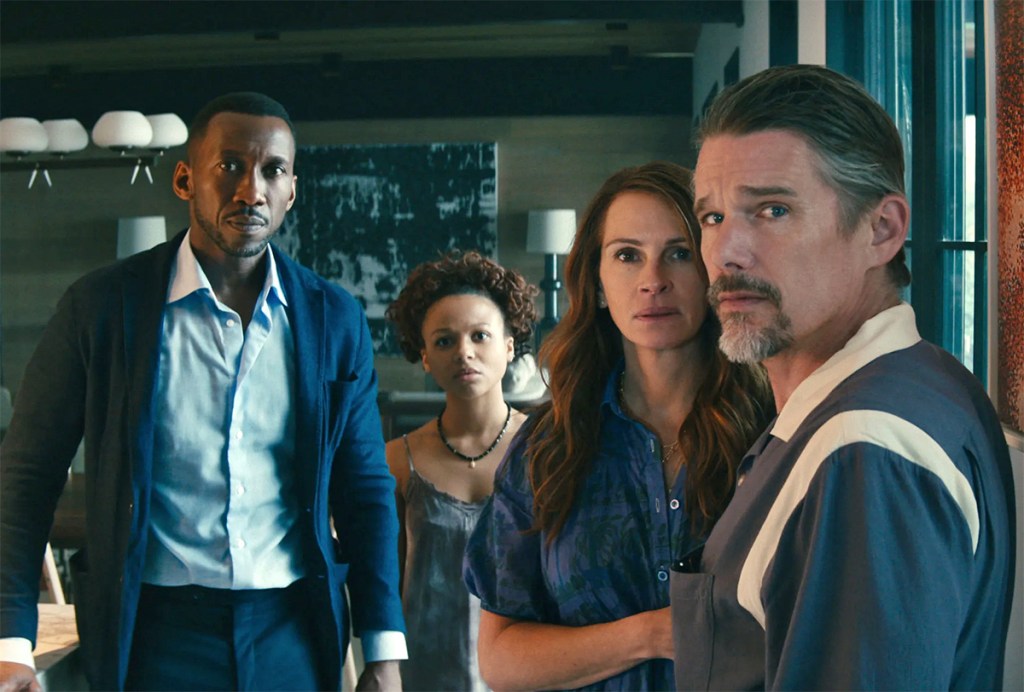
I like my apocalyptic drama and I liked many things about this adaptation of Rumaan Alam’s 2020 novel, even if my final thought was, I bet the book was better.
I’ve had Leave the World Behind on my reading list for months, but then Netflix got there first with their speedy film version, which seems to be causing quite a bit of discussion. It tells the story of an affluent Brooklyn couple, Amanda (Julia Roberts) and Clay (Ethan Hawke), who go on a spontaneous country getaway with their two teenage kids, after Amanda decides that they both need a break from their stressful jobs. Plus, Amanda says, a moment of clarity on a fine morning made her realise that she just hates people.
So off they go, and at first the family has a great time at their luxurious rental, if you look past the malfunctioning Wi-Fi and television… and a giant oil tanker that crashes directly into the beach before their disbelieving eyes. This unexplained disaster doesn’t unsettle them anywhere near as much as what happens on their first night at the property. A couple of complete strangers show up on their doorstep: a suave smooth-talking man in a tuxedo claiming to be the owner of the house, and his twenty-something daughter.
George (Mahershala Ali) and Ruth (Myha’la Herrold) explain that they’ve come to seek shelter at their holiday house after New York City has been hit with a disastrous blackout. Clay, who is more easy-going and genial, is receptive to their request to spend a night in the well-furnished basement, but Amanda is all suspicion and narrowed eyes before she reluctantly agrees. There’s a hint of prejudice in her distrust of George and Ruth, but the movie also drops verbal and visual hints that George seems to know more than he lets on.
In the morning, the two families wake up to a non-existent internet and cell service, and a general premonition that some bad, terrible, no good things are happening around them. They’re forced to stick together despite having no real reason to trust each other, but as things get worse, will their better natures win, or will they succumb to the darker human impulses when faced with the possibility of total collapse?
What worked for me the best is the movie’s ability to make this atmosphere of uncertainty, fear and impending doom feel palpable and frighteningly realistic, as the characters slowly realise that their old world has most likely vanished forever. It makes some brilliant points about our reliance on technology and how many of us would turn into helpless babies without internet and GPS. The oil tanker sequence is an early highlight, but there’s also a memorable set piece later in the film involving self-driving Tesla cars that’s both scary and absurd.
For the most part, the movie keeps a tight focus on its small cast of characters and their dynamics which, an odd clunker of a line aside, remain compelling. The four adult characters especially play off each other really well, with great performances all around. There’s also a brief but effective appearance from Kevin Bacon, in a chilling portrayal of someone who’s well prepared to survive in the new dog-eat-dog world.
Without getting into spoilers, I was fine with the movie’s controversial ending, maybe because the question of what exactly is going on and who is behind it all felt like one of the less interesting things about the movie. I also liked the gutsy lack of closure where characters and their dynamics are concerned; the only character who does get a closure of sorts gets it in a fully unexpected way that’s hilarious and tragic, and says something about the power of fiction whether you find it touching or pathetic.
Other than the unconvincing CGI deer in the climactic scene, my major complaints largely lie with the director Sam Esmail, who seems to see this movie as an excuse to employ every showy trick in existence: crane and drone movements, dizzying camera angles, zooms and pans galore, carefully composed shots that at times feel too self-conscious. I’m not at all against showy filmmaking, but here it simply felt distracting, as if Esmail didn’t trust the story and characters to stand on their own. While I liked the sets and cinematography with its splashes of vivid blue, the film had a strange TV movie vibe that I didn’t sense about, say, David Fincher’s recent The Killer. If someone told me that this was a pilot for a TV series, I’d probably believe them.
Annoying over-directing aside, the movie is always entertaining and I give it props for the atmosphere, intriguing exploration of divisions in our society, and strong character work. Now I’m even more keen to check out the original book.
 yggdrasille.com