

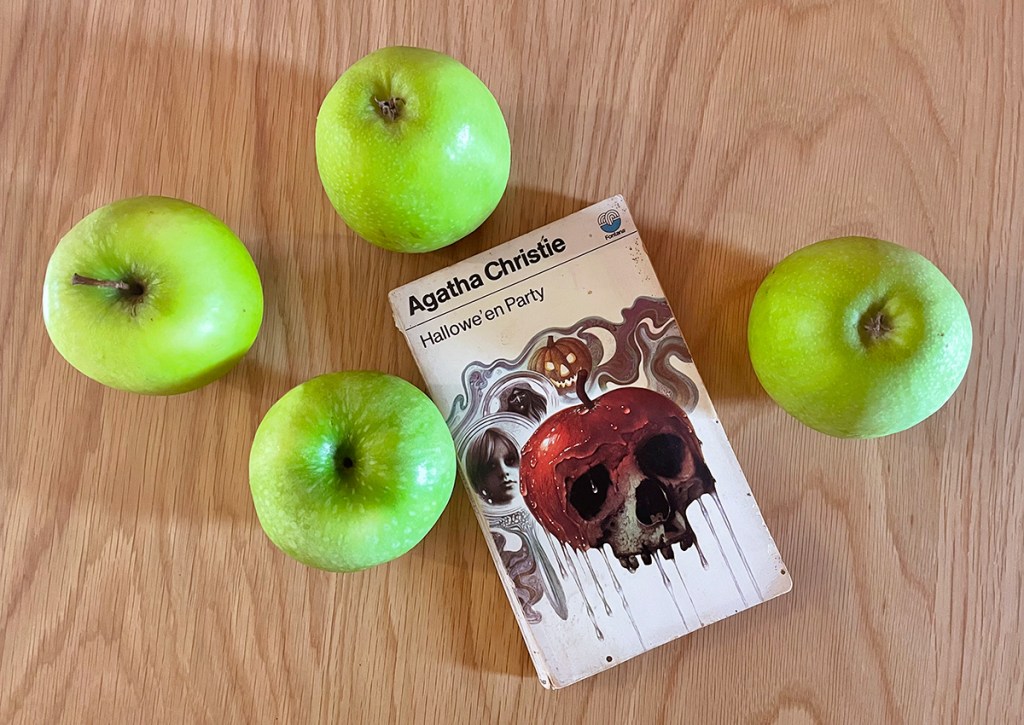
I had early hopes for this Poirot mystery promising Halloween-themed thrills and chills, but after a good start this short novel turns into a meandering slog that’s more duty than pleasure, despite some bright spots and interesting elements.
Credit where credit is due: even when Christie novels disappoint, they usually still have a strong and intriguing setup that pulls you right in. Here, the story kicks off with hectic preparations for a children’s Halloween party. Joyce, a girl aged thirteen, tries to impress celebrated mystery writer Mrs Ariadne Oliver by boasting that she once witnessed a murder. Joyce is known to be a compulsive liar and an attention seeker, and no one takes her seriously, until she’s found dead after the festivities are over, drowned in the apple-bobbing bucket.
The murder makes distraught Mrs Oliver lose all taste for her beloved apples, and seek out help of her good friend Hercule Poirot, who in turn looks up Superintendent Spence, an old acquaintance from Mrs McGinty’s Dead. By a happy coincidence, he and his sister happen to live in the village of Woodleigh Common, where Joyce’s murder took place. They bring Poirot up to speed on the local people, and any unusual or unexpected deaths that could have been the murder witnessed by the young girl. The story that grabs Poirot’s attention the most has a forged will, and a foreign au pair girl who disappears soon after the death of a wealthy old lady.
In addition, nearly everyone Poirot talks to has a variation on “kids these days”, lamenting the mental health crisis that puts unstable and oversexed young people out on the streets, and muttering darkly about children who may be warped from birth and beyond help. These anxieties over the modern world and its young people is a common feature of Christie’s twilight period, but here they’re really hammered in without much subtlety. I’m not sure if Christie seriously intended this possibility of a mindless, motiveless crime to be a red herring, if so I never really believed that Dame Agatha would switch gears that drastically so late into her career.
I’m always wary of raised expectations when it comes to later Christie, but for the good first third or so Hallowe’en Party is a decent page-turner, an odd rambling paragraph aside. Then you get smacked in the face by a chapter with a bizarrely excessive description of a garden Poirot visits, that made me feel like I got suddenly dropped into a different book entirely. In some way I appreciated Christie’s attempts to weave in the otherworldly, mythical and pagan elements, but they just don’t gel all that well with the rest of the investigation. The story never really recovers after that, and proceeds in a sluggish way, overburdened by redundant chapters and fruitless interviews that often repeat things readers already know.
Because of this disjointed quality, I felt quite ambivalent about the resolution. There’s a couple of clever tricks and sneaky clues that feel like classic Christie; there’s also a very silly and melodramatic climax and a secret relationship that doesn’t feel at all believable. I have a feeling that had Christie written this book twenty years earlier, she would have produced a much more polished and satisfying mystery, because the solid foundation is really there. The novel simply needs some serious pruning and more focused storytelling that would allow the reader to spend more time with the characters that actually matter.
P.S. I never expected an Agatha Christie novel to mention computers, which feels about as weird and jarring as her mentioning The Beatles.
P.P.S. Even though the book was a letdown, I’m definitely keeping the battered copy I got on eBay. It’s a fifty-year-old edition with a macabre cover art and an author blurb that movingly refers to Christie as a living writer, residing in a beautiful house in Devon with her husband. She would pass away three years later, in 1976.
 yggdrasille.com