

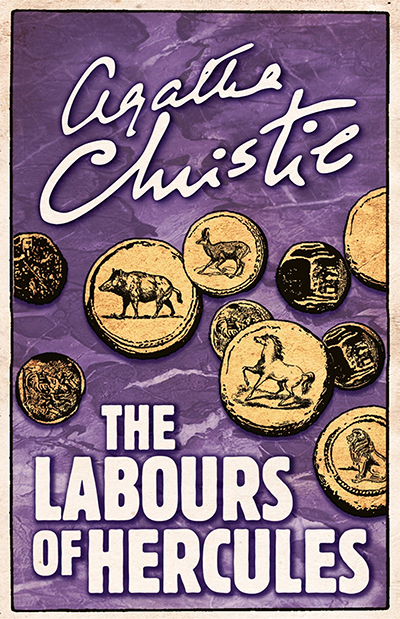
This imaginative short story collection, inspired by Hercule Poirot’s first name, riffs on the ancient Greek myths but with little grey cells replacing muscles.
Poirot is once again thinking of retirement, when he’s inspired to look up Hercules, the greatest mythical hero of ancient Greece famous for a cycle of twelve labours performed for King Eurystheus. Though Poirot is less than impressed with Hercules himself, a large muscular creature of low intelligence and criminal tendencies in his own words, there’s one point of resemblance he does finds flattering: both ancient Hercules and modern Hercule performed a valuable role in their respective societies by ridding the world of monsters. Not lacking in conceit, Poirot decides that before he dedicates himself to the cultivation of vegetable marrows, he would like to emulate his namesake, by solving twelve cases that somehow correspond to the twelve classical labours.
In the author’s foreword, Christie mentions that while some stories practically wrote themselves, finding suitable links with other labours proved to be a real challenge to ingenuity. As a massive Greek mythology nerd in my teens, I found this collection clever and enjoyable, and was more than willing to overlook its contrived aspects, for instance the idea that Poirot could conveniently come across the cases that fit his high concept just so and in the perfect order no less. Some stories are rather predictable, and some metaphors are more inspired than others, but overall it’s the strongest collection of Poirot short stories I read so far.
1. The Nemean Lion
The first story could actually be my favourite, partly because it hilariously subverts the idea of the classical fearsome beast. Poirot expects that his first case will involve a celebrated public figure, or a master criminal at the very least; instead he’s asked to investigate a disappearance of a pampered Pekinese dog belonging to a rich man’s wife. Despite his initial reluctance, there’s one small curious detail that makes Poirot accept the case. Another reason to love the story is the way it shows that, beneath his vanity and ego, Poirot also possesses a huge and generous heart.
2. The Lernean Hydra
This story draws a parallel between a monstrous nine-headed serpent killed by Hercules, and the malicious village gossip. To destroy the modern many-headed monster spreading poisonous rumours, Poirot investigates the death of a doctor’s wife that has the local tongues wagging.
3. The Arcadian Deer
Poirot always had a soft spot for young love, and here he helps a pining young mechanic with the appearance of a Greek god who reminds him of a shepherd in Arcady. This is one of the many stories in this collection where Poirot does a lot more international travel than usual, chasing after the Arcadian deer – a beautiful young woman who has disappeared without a trace.
4. The Erymanthian Boar
Poirot is on a holiday in Switzerland when he’s contacted by the local police force, asking for his aid in tracking down a dangerous criminal who has a rendezvous in the remote Swiss Alps. The twists and turns here were too easy to figure out, and generally I don’t think that violent thugs and Poirot mix well.
5. The Augean Stables
A change of pace, with Poirot getting involved in a political intrigue. His Herculean task is to avert a huge scandal that risks decimating an entire political party, by diverting the attention of the press elsewhere. I quite like the comparison between the world of politics and a massive stable full of stinking manure, but I don’t think that the metaphor here worked as well as Christie intended.
6. The Stymphalean Birds
A young Brit named Harold Waring is enjoying a holiday in Herzoslovakia (a fictional Balkan country first mentioned in The Secret of Chimneys), where he becomes acquainted with a charming mother-daughter couple. Also staying at the hotel are two elderly sisters, whose sinister appearances make Harold think of birds of ill omen. When he gets caught in a tricky situation that could potentially ruin his life, it’s up to Hercule Poirot to destroy the man-eating birds.
While entirely predictable, I enjoyed the story and the parallels with the spooky sisters from Don’t Look Now. What I didn’t enjoy was about sixteen pages missing from my copy of the book at this point, cutting off the ending of this story and a good chunk of the next one. I found the missing pages online, but this is simply unforgivable.
7. The Cretan Bull
In the original myth, Queen of Crete coupled with a handsome bull sent forth from the sea by Poseidon, and gave birth to the part man part bull monster Minotaur. This story is a lot less kinky: Poirot helps out a young lady whose fiancé, a handsome young man with the most magnificent physique, has broken off their engagement because he fears the insanity running in his family.
8. The Horses of Diomedes
The mythical mares captured by Hercules were fed on a diet of human flesh. Poirot’s targets are human monsters who profit from the degradation and misery of others by supplying drugs.
9. The Girdle of Hyppolita
Poirot solves a double mystery: disappearance of a Rubens masterpiece, and the case of a missing schoolgirl who inexplicably vanishes into thin air during the train trip. Though the mystery is solid, my favourite bit is the ending in which Poirot finds himself mobbed by excited schoolgirls wanting his autograph – for once he’s fêted by the younger generation who usually have no clue who Hercule Poirot is! Another amusing detail is the theft of the Rubens painting during a protest by the unemployed at the art gallery; the current-day climate activists obviously follow the long history of museums as a site of protest.
10. The Flock of Geryon
I can’t think of many Christie stories that tackle religious cults and charismatic leaders, but here Poirot helps out Miss Carnaby, a recurring character from the first story, who is seriously concerned about her friend’s involvement in a sect called the Flock of the Shepherd.
11. The Apples of the Hesperides
In his penultimate labour, Hercules was sent to fetch the golden apples from a magical tree guarded by a hundred-headed dragon. Poirot’s apples are beautiful emeralds decorating a stolen goblet that once belonged to the infamous and murderous Borgia Pope. This story is notable for exploring Poirot’s Catholic background, which rarely gets an explicit mention in the books, and an ending that has a strong flavour of a moral fable.
12. The Capture of Cerberus
In Greek mythology, Cerberus was a three-headed dog guarding the entrance to the underworld, which often and wrongly gets conflated with the Christian hell. In this last Poirot case, Hell is an edgy nightclub run by Countess Vera Rossakoff, an old acquaintance of Poirot, and Cerberus is a huge, hideous yet perfectly ordinary dog guarding the entrance. Vera is a reformed former criminal, but is she back to her old ways running a racket involving drugs and stolen jewels? Once again, my favourite part of the story is the ending, in which Poirot’s unflappable secretary Miss Lemon is shocked by an idea that her boss might harbour – gasp – romantic feelings.
P.S. By the end of it all, Poirot clearly forgets the initial premise behind his labours, i.e. retirement, which doesn’t get addressed in any way whatsoever. Unless the events of this book were supposed to happen right before The Murder of Roger Ackroyd, in which Poirot is actually found retired and growing his beloved vegetable marrows.
 yggdrasille.com