

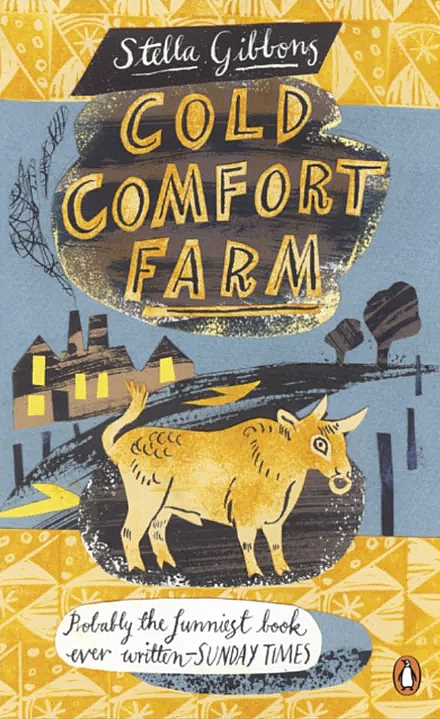
A send-up of the early 20th century rural novel, this sharp and funny parody clearly outlived its subject of mockery and stands on its own as a highly amusing read.
“On the whole I dislike my fellow-beings; I find them so difficult to understand. But I have a tidy mind, and untidy lives irritate me.”
So speaks Flora Poste, our urbane and sophisticated heroine, recently orphaned at the age of twenty. With mere hundred pounds a year to her name, and expensive education that made her accomplished at everything except earning her own money, Flora has two choices: she can either find a job, or rely on kindness of her various distant relatives. None of the latter are especially enticing, but Flora is intrigued by the offer from the Starkadder family, who live on a remote farm in Sussex and hint on a debt owed to Flora.
When she arrives at Cold Comfort Farm, Flora finds a bunch who are rough, moody, eccentric, and seem to live in a state of perpetual despair and bitterness, reflected in the dilapidated state of the farm. Flora’s aunt Ada Doom is a reclusive matriarch in control of the purse strings, tormented by the memory of ‘something nasty in the woodshed‘ that she saw as a child. Cousin Judith is prone to weeping in her room in between spells of sheer listlessness; her insolent son Seth is the stud from a thousand romantic novel covers and must beat women off with a stick. Amos, the man in charge, is a hellfire and damnation preacher; his son Reuben has ambitions for the farm and is initially suspicious of Flora. And there’s Elfine, a young and elusive nymph roaming the countryside and pining for the son of local gentry.
Flora has her work cut out for her if she wants to whip the farm into shape, but she relishes the challenge. She settles into her new life, and quietly works at loosening the iron grip Ada Doom has on the clan. Every Starkadder, she realises, harbours a deep unfulfilled personal desire, and if she can figure out what it is, she can help them escape or improve their miserable lives. By the end of the novel, Flora’s schemes are increasingly improbable, but we’re obviously not supposed to scrutinise them, or Flora’s own rushed romantic resolution for that matter, too closely.
As a meddlesome heroine, Flora is supremely confident without being smug or unbearable, and a few moments of self-doubt she does have help keep the reader on her side. She may not approve of the Starkadder messiness, but she never shows contempt towards them, and grows to genuinely like some family members. Mostly, she’s just out to have fun and she doesn’t take herself too seriously. I couldn’t help but like her brisk, no-nonsense pragmatism, especially when it contrasts with the doomy, melodramatic utterances from the farm denizens.
I missed the note at the start of the book clarifying that the story takes place in the near future, and so I was constantly puzzled by small weird details like video phones, Anglo-Nicaraguan wars of 1946 and Clark Gable referred to as an old movie star. I guess you couldn’t blame Stella Gibbons for not predicting World War II back in 1932. Other bizarre details include cows that mysteriously lose their legs, and sukebind, an invented weed that symbolises the oppression hanging over the Starkadders and their farm.
Though I’m unfamiliar with the authors whose “earthy” novels are parodied here, it helped to be aware of the author’s intentions. Otherwise, I’d probably have no idea what to make of the occasional paragraphs marked with **, where the narrator would launch into hilariously overwrought purple passages that are meant to give you a taste of the over-the-top writing Gibbons is satirising. But even if I didn’t read the blurb on the back cover, I’d still find Cold Comfort Farm a superb comic novel, with many lines and descriptions that made me chuckle out loud. Cows named Graceless, Pointless, Feckless and Aimless are just funny whether you pick up this book in 2026 or nearly a century ago.
 yggdrasille.com