

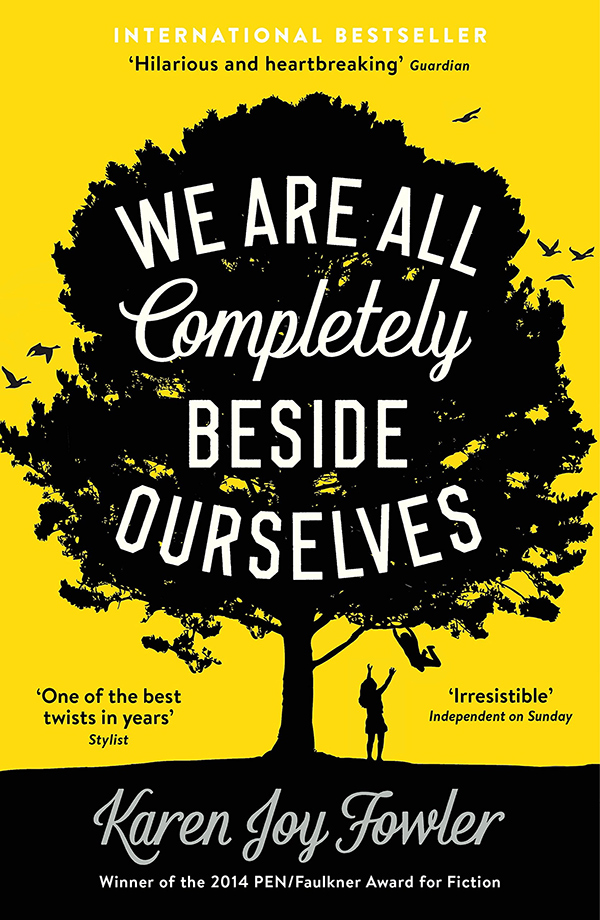
Each unhappy family is unhappy in its own way, as the famous Leo Tolstoy quote goes. It’s fair to say that the unhappy family in this quirky and zestful novel is quite unlike anything else I’ve read about.
Our self-confessed unreliable narrator is Rosemary Cooke, a woman we first meet as a twenty-two-year-old university student who gets wrongfully arrested for spilling a glass of milk in the school cafeteria. Because of this incident, a fellow student named Harlow explodes into Rosemary’s life like a confetti bomb. Harlow is a roguish, irresponsible and untrustworthy character, but her chaotic energy reminds Rosemary of her sister Fern, an exuberant whirlwind who disappeared from her life seventeen years ago. It’s also been ten years since she last saw her older brother Lowell.
Rosemary is clearly a troubled, damaged soul, and the entire novel with its shifting timeline is about her working up to the moment when she can finally confront her long-suppressed memories about the role she played in Fern’s disappearance, a tragedy that tore her family apart and led to her brother turning into a fugitive wanted by the FBI. Dysfunctional families is one of my personal favourite literary tropes, and this novel was shaping up as another well-written suburban family drama with a slice of mystery on the side… until it throws in a game-changing twist about a quarter in. To say that it makes the reader see the whole story in a different light is a massive understatement.
I won’t spoil the twist even if it makes reviewing this book tricky, since you can’t bring up some of its major themes without revealing the surprise. Suffice to say that Rosemary’s early childhood was an unusual psychological experiment conducted by her scientist father. In many ways, it’s moulded her into a perpetual outsider who doesn’t quite fit in with the rest of the human race. In retrospect, there’s enough subtle foreshadowing for some readers to guess what’s coming, but the reveal left me utterly gobsmacked. Accepting these redefined family dynamics was a challenge I initially struggled with, so it’s to Fowler’s credit that the unconventional sibling relationship at the heart of the story is credible and moving. In fact, it is a scenario so ripe with possibilities it made me wonder why I haven’t encountered it in fiction before.
This is also a book about memory and the way we protect ourselves from our painful past by constructing convenient narratives. Rosemary admits early on that her memories are what is described as ‘screen memories’: a compromise between remembering something painful and defending yourself against that very remembering. She often interrupts herself and backtracks to the earlier scenes, to revise her story and disclose whole chunks of dialogue previously withheld. All throughout the novel, you get a sense of her chipping away and getting closer and closer to the truth, while simultaneously recoiling from it.
As a narrator, Rosemary is sardonic, edgy, wry and funny, not always likeable but always engaging and entertaining. Her fallible perspective perhaps does the remaining characters a disservice; for all their eccentricities, it’s hard to get a grip on them and be properly invested when they morph and shift throughout the story. Unreliable memory is of course the point here, but it does leave Rosemary the only fully realised character in the book. She was such an enjoyable company however that I could overlook these deficiencies.
I also enjoy the kind of spiky, zingy, hyperactive writing style Fowler has here, which helps the novel’s messages go down way easier without coming off as too preachy. At times it can get a tad too self-consciously clever and quirky, and my finger got itchy during an account of a wild night out that went on for far too long, but these quibbles don’t really mar this juicy, original and thought-provoking book.
 yggdrasille.com