


I enjoyed Dan Simmons’ sprawling novel about the doomed Franklin expedition, and this handsome, well-acted adaptation does justice to the haunting story of 19th century Arctic horror and survival.
Both the book and the miniseries are loosely based on the real-life tragedy of HMS Erebus and HMS Terror, which set off for the Arctic in 1845 in hopes of finding the Northwest Passage. The two ships and their men vanished, never to be heard of again; the remains of the expedition found much later suggest that the survivors might have resorted to cannibalism. In his absorbing fictionalised account, Dan Simmons re-imagined the story as supernatural horror, an angle that I eventually appreciated.
In the miniseries, we join the crew already far into their trip, powering aboard the warships retrofitted to be ice breakers. The men are headed by Sir John Franklin (Ciaran Hinds) and Captain Francis Crozier (Jared Harris), who already lock horns early on due to their differing outlooks. Franklin is eager to press on despite the ominous signs of impassable ice ahead of them, against the objections from Crozier whose experience and knowledge of the Arctic is far superior. Unfortunately, Crozier is also a spiky, gloomy Irish alcoholic who rubs his superiors the wrong way, and gets dismissed by both Franklin and his snooty second, Commander James Fitzjames (Tobias Menzies).
(It always warms my heart to see the cast of Rome pop up in other productions, and here I chuckled a bit at the sight of Julius Caesar and Brutus in the Arctic).
Sure enough, the two ships get trapped in the ice, with a long dark winter coming. As dismal as it sounds, this eventuality was accounted and planned for, with enough supplies brought along to last until the thaw of spring. The first couple of deaths from drowning and consumption are likewise nothing out of the ordinary on a long, dangerous voyage. But after Franklin’s crew accidentally kill a native Inuk man, they are haunted by a giant creature they first assume to be an oversized polar bear. It is however something else entirely, a vengeful spirit in the form of a beast, an embodiment of the landscape that’s out to kill them all.
As the ice slowly crushes the ships in its grip, the men are worn down by the darkness, bitter cold and malnutrition; their own tinned supplies turn out to be poisoning them with lead. What initially looked like an unfortunate delay that could cost them the Northwest Passage becomes an existential threat that could cost them their lives. In this soul-crushing atmosphere, the darkness of the mind eventually gives way to division, mutiny and catastrophically bad decisions.
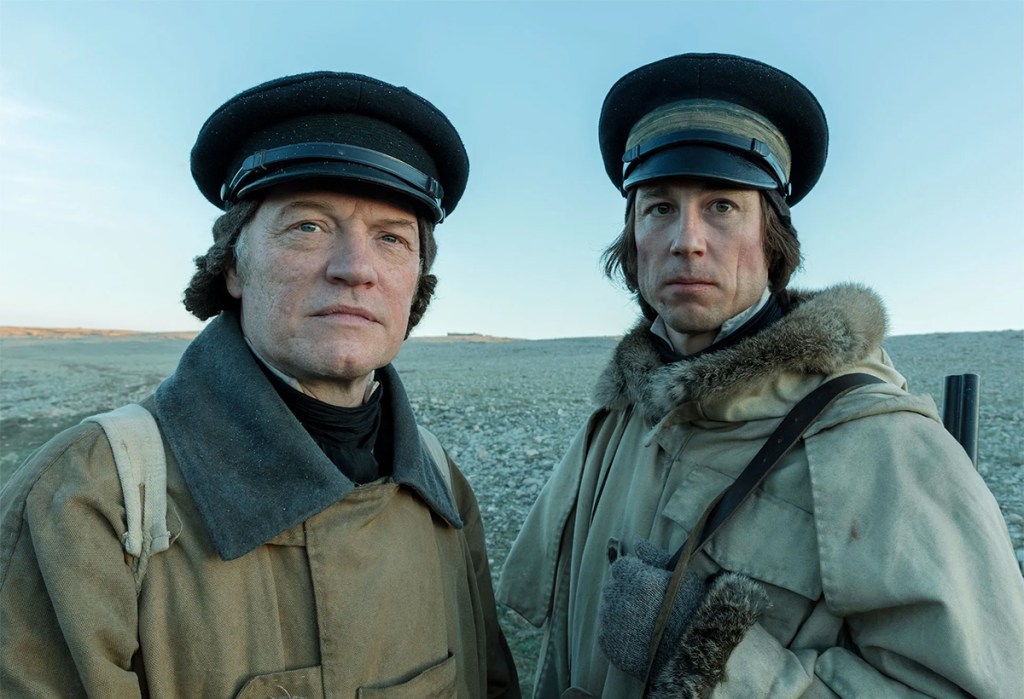
It goes without saying that The Terror is not an easy watch, especially in its final, utterly bleak stretch that in retrospect makes the first few episodes seem a picture of normality and order. Early on there are also multiple flashbacks to the good old comfortable England, filling in the backstory of the expedition and the personal history of its two captains. These escapes become rare and few as the viewer gets trapped in the plight of the men stuck in the ice. What prevents it all from turning into pure unrelenting misery porn is the bright moments of genuine friendship, loyalty, empathy and personal triumph that provide some relief and uplift.
There is a kind of stark, eerie beauty to be found in the harsh, lifeless Arctic landscape, which gives the series a startlingly unique look. Early on, the sheer isolation of the men really comes through in a stunning aerial shot depicting Terror and Erebus as two tiny black dots on a sheet of white. On occasions, the limitations of a TV budget do betray themselves in the scenes that have a somewhat stagey feel, and of course there’s a limit to what the actors can realistically be put through in order to portray cold and disease-ravaged men on a brink of starvation. Overall, the production design, make-up and costumes do a top job transporting the viewer into the 19th century Arctic, and showing the devastating effects of time. The only true visual misstep is the less-than-perfect CGI for the mystical beast, whose appearances are at least kept spare.
I remember having trouble keeping track of Simmons’ massive cast of characters while reading the book, and it likewise took some time for the many supporting characters to distinguish themselves while watching the series. It helps to have familiar, rock-solid actors anchoring the show, especially Jared Harris whose Crozier goes on a remarkable arc as he’s forced to become the leader his men badly need him to be. Adam Nagaitis is another highlight playing wily, scheming Cornelius Hickey, the chief human villain of the series and one of the more memorable antagonists I’ve seen lately. As despicable as Hickey is, there’s a devilish spark and vitality to him that can’t help but draw you in.
I was very curious to see how the series would handle Simmons’ batshit insane last chapters that descend into full-blown mysticism. Understandably, the writers must have concluded that the book’s out-there ending, including a subplot involving the show’s only major female character, an Inuk woman with a connection to the beast, would be a hard sell for the TV audience. I had no problem with the re-write that still keeps the broad strokes of the story intact, but a small part of me would have liked to see them try.
 yggdrasille.com
I haven’t read the book but I’ve been loving the show on Netflix – I’m up to episode 6!
LikeLiked by 1 person