

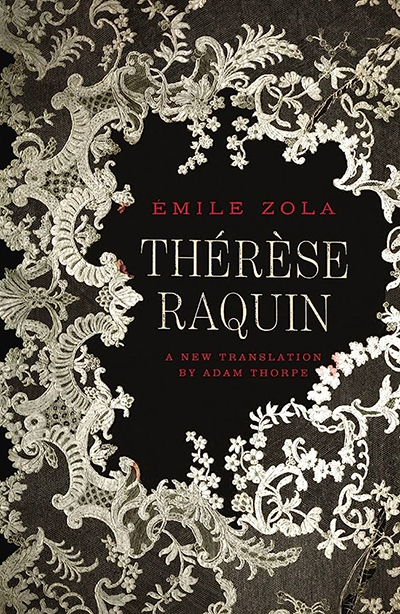
This claustrophobic tale of lust, murder and madness made an indelible impression on me when I first read it many years ago, and I found it just as engrossing second time around.
These days it can take me weeks to finish a book, but I tore through Zola’s classic in a matter of hours, which is probably the best way to read this relatively short novel. Taken in one gulp, it really delivers a knockout punch with a tale that’s both sickening and fascinating.
The story is set in Paris – not the glamorous Paris of boulevards and tourist sites, but the dank and grimy Paris of poorly lit backstreets, where a young woman named Thérèse is languishing in a loveless marriage to her cousin Camille. The couple live with Thérèse’s aunt Madame Raquin, who owns the downstairs haberdashery shop and who adopted Thérèse when she was abandoned by her father as a child.
Raised in a smothering and overprotective atmosphere to be basically a support human to sickly Camille, Thérèse has long learned to suppress her vitality and passionate nature under a passive, docile mask. When she meets Camille’s old friend Laurent, a vigorous man of robust peasant stock and hedonistic appetite for pleasures, the two embark on a turbulent, feverish affair. You can easily see why Zola’s portrayal of adultery and desire ruffled the 19th century feathers.
Eventually the two secret lovers come to see Camille as an irritating obstacle stopping them from being together, and so a murderous plot is hatched and put into action with relative ease. What Thérèse and Laurent don’t foresee is that the memory of the dead man will haunt them both, destroying their sanity and killing their passion, and that the mere sight of each other will become unendurable. The murder takes place about a third into the story, so the rest of the novel chronicles the lovers’ mental anguish and slow, agonising descent into madness.
First published in 1867, Thérèse Raquin caused quite a scandal and was denounced by the critics as ‘a pool of filth and blood’. Zola’s defence against the accusations of obscenity was to claim that his work was merely a scientific study of human animals, lacking free will and driven by their temperaments, where his job as a writer was to clinically observe the sensations and actions of characters plunged in a violent drama.
To a modern reader, the moral pearl-clutching of the critics sounds pretty ridiculous, but to be honest so do Zola’s claims of naturalism, and not just because the entire four temperaments theory is pretty dated nowadays. I haven’t read the rest of his novels, but Thérèse Raquin is simply too over-the-top to read as anything else than a gothic horror/melodrama, complete with excessive emotions and extravagant, floridly gruesome descriptions that would make Edgar Allan Poe nod with approval.
On that level, however, Zola’s novel is extremely effective. There’s weight and visceral quality to his depictions of the gloomy, dingy atmosphere the characters are trapped in, and the palpable presence of dead Camille in characters’ tortured minds. One of the most ghoulishly memorable parts of the book takes place at a city morgue, visited for entertainment by people from all walks of life, coming in to look at the hideous corpses displayed on the slabs.
Thérèse’s suffocating upbringing and empty, soul-destroying marriage make her a fairly sympathetic character at first, however this is not really a book with characters you can like and root for. After finishing it, I didn’t wish to go near anything remotely depressing for the rest of the weekend, and as a cat lover I found one particular passage especially upsetting. But there’s no denying the power of Zola’s writing and the dark, perverse tale he weaves.
 yggdrasille.com