

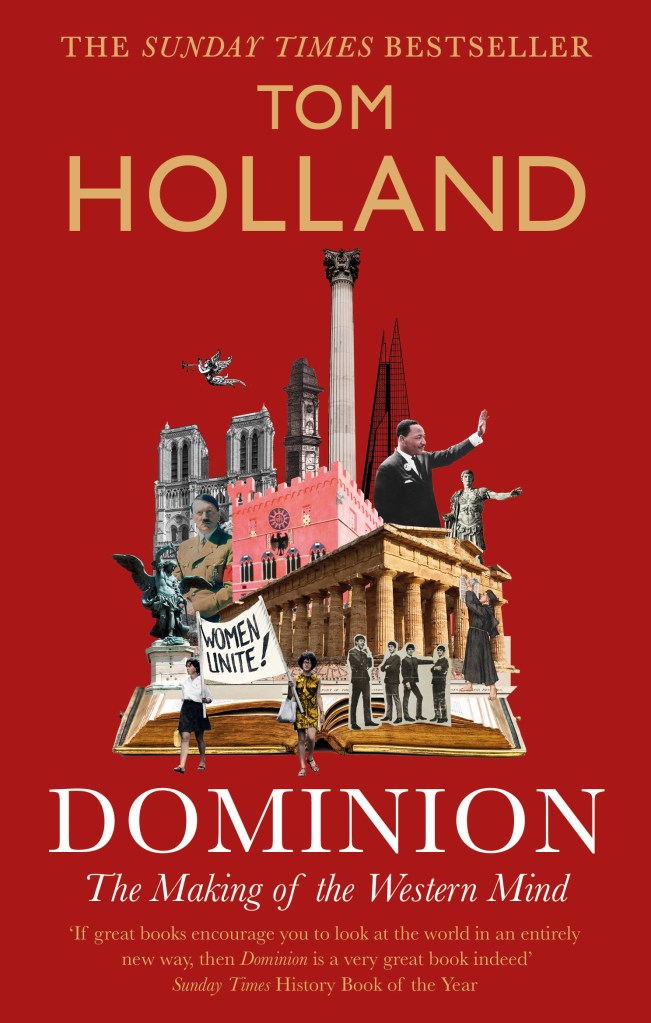
An absorbing, ambitious and well-written journey through history of Christianity, its impact on the western culture, and its enduring influence in the modern world.
In the introduction, Tom Holland (who must be sick and tired of Spider-Man jokes) writes how, as a young boy, he experienced a crisis of faith thanks to his obsession with dinosaurs, so glaringly incompatible with the Bible stories. As an adult, he was seduced by the glamour of the ancient empires, the Persians and the Romans, magnificent and terrible apex predators of their day. Yet the more time Holland spent immersed in the study of antiquity, the more alien its morals and ethics felt to him. Eventually, he was forced to conclude that, regardless of how little religious faith he had, culturally he was a Christian through and through.
According to Holland, some of the things we owe Christianity that would have drawn blank incomprehension from ancient Greeks and Romans are the distinction between the religious and the secular, belief in love, progress and intrinsic value of every person, concern for the weak and the poor. He does a brilliant job of conveying just how weird and transgressive Christianity appeared to the Roman society it emerged in, who found the notion of worshiping a man executed as the lowest possible criminal utterly bizarre. In fact, so radical were these ideas that even the founders of Christianity like Saint Paul, who was still a product of his upbringing, found it hard to accept the logical conclusion of all people, men and women, being equal before God, and what it would mean for the society. Likewise, it took centuries before religious groups like the Quakers came to the conclusion that the institution of slavery is grossly offensive to the Christian morals.
Dominion is not, strictly speaking, about the history of Christianity, even if it moves through the centuries in a chronological order. Rather, Holland uses every compact chapter to highlight a specific point or event in history, shed light on its significance, both in its immediate context and future implications, and draw parallels with the past. We’re taken from ancient Persia to Greece and Rome, from the medieval Europe to French Revolution, down to the modern day of Tolkien, The Beatles and Angela Merkel. Along the way, it gives brief but vivid portraits of key figures like Martin Luther, and obscure but fascinating individuals like Maifreda da Pirovano, a 13th-century noblewoman who declared that she was destined to be elected pope, a modest claim that absolutely didn’t ruffle the feathers of the church.
Because the scope of the book is so vast across its 500 pages, it comes with limitations. As a Russian-born, I would have loved Holland to give some attention to the Eastern Orthodoxy as well as Roman Catholicism and Protestantism. I also wished for the book to go more in-depth on things like the Protestant Reformation, though understandably it’s a subject that could fill 500 pages on its own. Holland is a wonderful storyteller who makes the complex history and ideas as accessible to a non-academic as can be, but this is definitely a book that demands your full attention and concentration. It does help that Holland tends to end every chapter with a hook for the next chapter, just like a good thriller writer.
Holland’s thesis – that the values and principles we in the western world hold today are not in the least bit instinctive and would not exist without the 2,000 years of Christian dominance – is likely to make some people uncomfortable. I’ve no doubt that it would be met with visceral resistance from my younger self, back when my atheism was of a more militant nature and I had nothing but disdain for the organised religion. I still recognise the corruption, oppression and horrors inflicted as a result of Christianity, as does Holland who certainly doesn’t let it off the hook. But at this stage, I’m more open to also acknowledging its beneficial legacy, so profound and deeply ingrained it’s virtually hidden from view. A point Holland keeps making over and over is that even the criticism of Christianity’s failings tends to come from a position that is itself unmistakably Christian.
Another recurring point here is the tension and instability inherent in a religion of have-nots that rose from the bottom up, rather than down from the top. The paradox is that every revolution and renewal would inevitably breed a new complacent elite, and a new bunch of radicals intent on purifying the church and stripping the world of sin and corruption, a cycle that went on for centuries even after religious faith itself started to dwindle. In a chapter set in the early 20th century, Nietzsche speaks contemptuously of the socialists, communists and philosophers supposedly rejecting Christianity and envisioning a new world without God, while still clinging to the Christian morality.
It’s impossible to touch on everything covered in Dominion, but some of the most interesting chapters to me were the ones that challenged some long-held assumptions, such as the idea that the persecution of Galileo was a black-and-white matter of church vs science (it in fact involved wounded egos and wider societal religious tensions). Reading about the Gregorian Reforms also made me see separation of church and state in a different light; I’ve always assumed it to be about the state separating itself from the influence of the church, but it never occurred to me that it can also work the other way around.
I did think that Holland’s reasoning got somewhat weaker the further he went into the modern era, but overall I found Dominion a compelling and persuasive read that came my way at the right time.
 yggdrasille.com
Books like this help me look at my thinking and question assumptions I take for granted. Thank you for sharing it with us.
LikeLiked by 1 person